Why this article exists
Metal sheds are the default shed of American suburbia. Walk into a Home Depot or a Lowe's in May and you'll see a row of them standing in the parking lot — an Arrow, a Suncast-metal, a Duramax — with price tags between $299 and $899, ready to be loaded into the back of a truck. They represent roughly 48 percent of the U.S. shed market by value, which makes them the single biggest category in the country, and they are the reason somewhere around a million American backyards have "a shed" even though almost nobody dreamt about one specifically.
The problem isn't that metal sheds exist. The problem is that "metal shed" is probably the most misleading shed category on the market, because the distance between a 29-gauge Arrow Classic at Walmart and a 14-gauge engineered Quonset hut from a commercial metal-building company is so enormous that calling both of them "metal sheds" is like calling both a Kia Rio and a Ford F-350 "vehicles." Yes, technically. But if you don't understand which end of the spectrum you're buying into, you will walk out of a big-box store with a $500 shed that is quite genuinely thinner than a credit card in the walls and expect it to do the job of a building.
This guide is about closing that gap. By the end of it you'll know what metal gauges actually mean, why a $300 shed fails at 80 mph and a $4,000 shed doesn't, why the condensation problem is physics and not a defect, and how to figure out which of the roughly four completely different kinds of "metal shed" actually fits what you're trying to do. We'll also be honest about when a metal shed is the genuinely right call — because it sometimes is — and when the cheap metal option is going to leave you staring at a crumpled heap after the first real snowstorm.
What a "metal shed" actually is
The term covers at least four meaningfully different products, and the single biggest mistake new shed buyers make is treating them as variations of the same thing. They aren't. The four categories are:
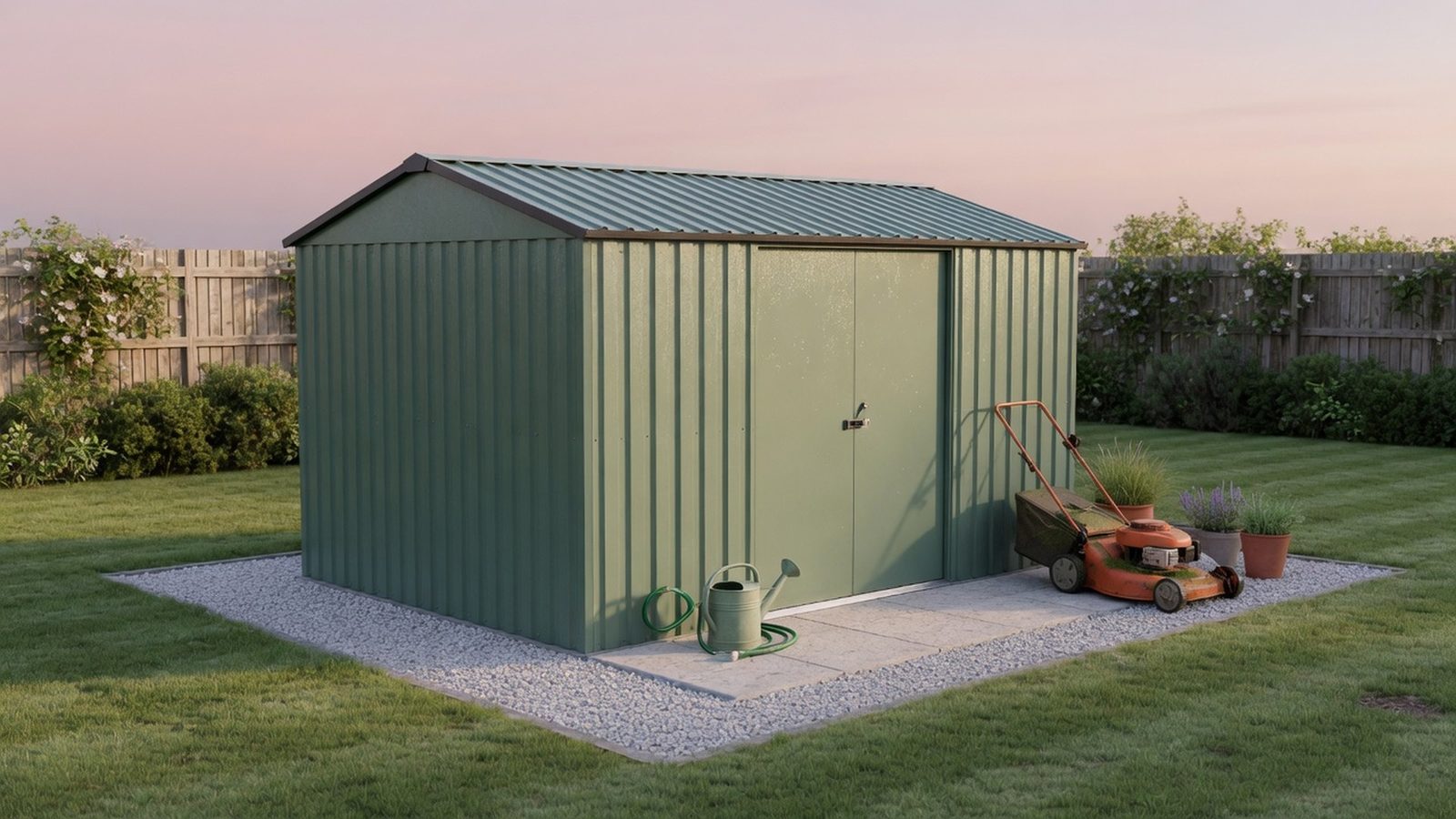
Category 1: Big-box entry-level steel kits. Arrow, Suncast-metal, Duramax, and similar brands sold at Home Depot, Lowe's, Walmart, Amazon, and Costco. Price range roughly $300 to $1,500. These are made from very thin galvanized or pre-painted steel panels — sometimes as thin as 0.009 of an inch, thinner than a credit card — fastened to a light tubular steel frame. They bolt together with several hundred self-tapping screws. They come flat-packed on a pallet and typically take a weekend for two people to assemble, if the instructions work as intended.
Category 2: Mid-tier residential steel sheds. Brands like Absco (Australia, imported), higher Duramax models, Sojag, and some Arrow Elite products. Price range roughly $1,000 to $3,500. Heavier gauge panels (typically 26-gauge on walls, 24-gauge on roofs), more substantial framing, better weather resistance, and usually actual engineering documentation that tells you what wind and snow loads the structure will handle. If you have never seen an "engineering certification letter" for a shed, this is the tier where it starts to exist.
Category 3: Engineered steel buildings and Quonset huts. SteelMaster, Mueller, Morton, Wick, and similar commercial/residential steel-building companies. Price range roughly $3,500 to $30,000 depending on size. 14-gauge to 22-gauge structural steel, proper engineered drawings, typical 20- to 40-year warranties on steel and coatings, often requires a concrete foundation and sometimes a permit. These are the "steel buildings" you see on farms and rural properties — not kits you pick up at the store, but products that get delivered on a flatbed and assembled over several days.
Category 4: Metal carports, garages, and pole-barn-style buildings. Distinct enough that we'll mostly leave them to another guide, but worth naming so you know they exist. Viking Steel, American Metal Garages, and similar brands build open carports and enclosed garages in the $1,500 to $30,000 range.
The thing to understand is that almost all of the reviews, photos, regret stories, and horror-show anecdotes you will find online about metal sheds are about Category 1 — the $300 to $1,500 big-box kits. They are the most common metal shed by volume, they are the cheapest, and they are the category where the documented failure modes pile up fastest. When you read a forum post about a metal shed that "collapsed in a mild snowstorm" or "started rusting at the base in two years" or "arrived bent and missing parts," you are almost always reading about a Category 1 shed.
Categories 2 and 3 are a different world and they are the world almost nobody writing about metal sheds on Pinterest actually covers. For the rest of this article, when we say "cheap metal shed" we mean Category 1, and when we say "quality metal shed" we mean the top of Category 2 and into Category 3.
The one number that matters: gauge
If you take nothing else from this article, take this:
Gauge is the single most important specification on any metal shed, and lower numbers are thicker steel.
The gauge system is counterintuitive. It's a legacy of wire-drawing history and there's no shortcut — you just have to memorize it. Here's the basic reference table:
- 14-gauge (0.0747 inches / 1.90 mm) — commercial-grade structural steel, used in the frames of engineered metal buildings and Quonset huts. This is what a proper steel garage is made of. It is also not what a Home Depot shed is made of.
- 20-gauge (0.0375 inches / 0.95 mm) — very heavy-duty residential panels, found in premium sheds and in hail-prone regions.
- 22-gauge (0.0299 inches / 0.76 mm) — heavy-duty panels used in commercial applications and hurricane-zone residential work.
- 24-gauge (0.0239 inches / 0.61 mm) — premium residential standard. Good for high-wind and high-snow areas.
- 26-gauge (0.0179 inches / 0.46 mm) — the recommended minimum for most residential applications where weather matters. Standard choice for legitimate garages, barns, and workshops.
- 29-gauge (0.0142 inches / 0.36 mm) — entry-level shed panels. Suitable for mild climates and pure storage use. Dents easily.
- "Below 29-gauge" — this shouldn't exist as a category, but it does. Arrow Classic wall panels measure approximately 0.0088 inches, which is thinner than a credit card (~0.030 inches) and thinner than any standard gauge. This is what most of the cheap big-box sheds are actually built from. Nobody puts "sub-light-gauge" on a marketing sheet, but that's what it is.
The gauge delta from 26 to 29 sounds small — 0.018 inches vs 0.014 inches — but in practice it's the difference between "a structure that shrugs off hail and moderate snow" and "a structure that dents when your dog leans against it." The delta from 29-gauge to Arrow-Classic thickness is another cliff: you are below the threshold where the metal can meaningfully resist impact or hold shape under load.
When you shop for a metal shed, ask for the gauge of the wall panels, the gauge of the roof panels, and the gauge of the frame separately. A reputable seller will tell you cleanly. A seller who dodges the question or gives you a vague "heavy-duty galvanized steel" answer is telling you something useful about what they're selling.
Is a metal shed actually right for you?
Metal shed buyers usually fall into one of a handful of emotional camps, and knowing which one you're in matters more than any spec sheet. Here are the real ones:
The budget-first buyer. Your garage is overflowing, your spouse wants the mower and the holiday decorations out of the house, and you want the cheapest possible solution that won't look completely terrible from the kitchen window. You are the single largest category of metal shed buyer, and the trap you need to watch is the hidden-cost trap. A $500 metal shed at Home Depot is not a $500 project. By the time you add the required foundation ($200 to $500 for a proper pad), the anchor kit the manufacturer recommends ($30 to $75), the floor kit (often $75 to $150, because many metal sheds ship with no floor), caulking and sealing ($20 to $50), and maybe a couple of reinforcement pieces after you read the assembly reviews ($100 to $300), you are at $1,000 to $1,500 all-in. At that number, the gap between a cheap metal shed and a decent wooden shed or a mid-tier metal shed narrows dramatically, and it's worth asking whether the cheap option is actually the cheap option.
The rural or farm buyer. You need weatherproof storage for equipment, hay, tools, or vehicles, and you need it now on a property measured in acres. For this buyer, metal is frequently the right call — but the right call is almost never a Home Depot kit. It's an engineered steel building from a regional metal-building company, probably with a concrete slab, probably with 14- or 22-gauge structural framing, probably with an actual engineering drawing. The money difference is real ($3,000 to $15,000 vs $500), but the product difference is enormous, and the consequences of failure — crushed ATVs, ruined equipment, destroyed feed — make the value calculation lean hard toward doing it right.
The workshop buyer. You want a dedicated workspace — woodworking, metalworking, hobby projects, auto work. If this is you, we need to have a real conversation. Metal sheds are catastrophic for workshop use, and we'll explain why in the condensation section below. In short: metal conducts heat and cold approximately 400 times faster than wood, which means your metal shed will be 120°F in July, 20°F in January, and dripping with condensation every morning in between. Your cast-iron tools will rust. Your glue will fail. Your electronics will be unhappy. If you want a workshop, the metal shed is almost never the right starting point, no matter how attractive the price is.
The rental-property buyer. You own rentals and you need storage that doesn't generate maintenance calls. Metal is tempting because it's cheap, but rental-context wear and tear destroys cheap metal sheds faster than owner-occupied ones. Dents, stuck doors, corrosion at the base, and broken sliding-door tracks all accumulate quickly when the end user has zero personal investment in the structure. For rentals, the math often favors either a very cheap shed that you plan to replace every five to seven years (treating it as a consumable), or a significantly better shed that holds up for fifteen to twenty.
The security-conscious buyer. You want a structure that resists break-ins. Metal sheds get credit for this because they "look" secure, but the truth is more complicated. A thin-gauge metal shed can be cut open with tin snips or a reciprocating saw in under a minute. A heavy-gauge metal shed with a proper lock and hinge geometry is genuinely hard to break into. If security is your priority, the gauge question is not optional — you need to be in 22-gauge or thicker territory, and you need to understand that the lock assembly is usually the weak point, not the walls.
Galvanized, Galvalume, powder-coated — what actually matters
The metal shed industry throws around coating names like buyers are supposed to already know what they mean. Here's the honest explanation:
Galvanized means the steel is coated in zinc. Zinc is more reactive than iron, so it corrodes first, sacrificially — the zinc "takes the hit" for the steel underneath. In rural conditions, hot-dip galvanized steel can last 80 years before rust becomes a maintenance issue. In coastal direct-salt-spray conditions it's more like 20 to 30 years. Most entry-level metal sheds use galvanized panels because it's the cheapest effective corrosion protection.
Galvalume is a newer coating — roughly 55 percent aluminum, 43 percent zinc, and a little silicon. The aluminum adds a barrier layer on top of the sacrificial zinc behavior, and the result is a coating that lasts roughly 50 percent longer than straight galvanized in most environments. Galvalume also performs better under high heat and UV, which matters for dark-colored roofs in hot climates. Galvalume costs about 10 to 15 percent more than galvanized. For premium residential metal sheds in hot or coastal climates, it's a real upgrade.
Powder coating is a decorative finish applied over the galvanized or Galvalume substrate. Dry polyester or epoxy powder is electrostatically deposited onto the metal and then baked on at 350 to 450°F. It's tougher than paint, it covers edges better than liquid finishes, and it lasts up to 20 years outdoors before chalking begins. A powder-coated galvanized shed is the standard specification for a quality residential metal product.
Baked enamel is a cheaper finish that's usually found on low-end sheds. Outdoor lifespan is roughly 5 to 10 years before visible degradation. If a product spec says "baked enamel" instead of "powder coat," it's telling you where on the quality ladder you are.
PVDF (Kynar/Hylar) is the premium architectural coating, used on commercial-grade standing-seam roofing and on the highest-tier residential products. Proven 30+ years in service. You will almost never see PVDF on a sub-$2,000 shed.
The thing to remember is that all of these coatings protect the metal until the metal is scratched or dented, at which point bare steel is exposed and rust starts at the damaged spot. This is why the rust stories you see in reviews almost always start at a specific injury point: a scratch from assembly, a dent from a fallen branch, an unsealed screw hole, a cut edge the manufacturer didn't touch up. The coating is only as durable as the layer underneath, and a thin 29-gauge panel is easy to damage even during assembly.
The condensation problem is physics, not a defect
This is the single most common complaint in metal shed reviews, and it's the one that most new buyers don't see coming: metal sheds sweat on the inside, and the sweat ruins the things you're storing.
The physics is simple. Steel is a phenomenal thermal conductor — it equalizes to the outside temperature in minutes. Wood, for comparison, conducts heat about 400 times more slowly, so a wooden wall buffers temperature swings for hours. When the warm, moist air inside the shed (whether from rain last week, from summer humidity, or just from the ground beneath) meets the suddenly-cold metal surface of a wall or roof after a cool night, the air hits its dew point at the metal surface and drops its water as condensation. By morning, the interior of a metal shed in humid weather is literally wet. By noon, the sun has evaporated it. By the next morning, it's wet again.
What this does to your stuff:
- Cast iron and steel tools develop surface rust within weeks. If you store hand tools, table saws, drill presses, or anything else with exposed iron surfaces in a metal shed, you are on a maintenance treadmill forever. The forums are full of woodworkers who bought metal sheds for workshops and then watched their tool collection start rusting.
- Paper and cardboard absorb the moisture and rot. Any cardboard box stored in a metal shed is on borrowed time.
- Leather and fabric mildew.
- Electronics — charge controllers for solar setups, battery chargers, anything with a circuit board — degrade faster than expected.
- Wood furniture or stored lumber absorbs moisture, swells, and deforms.
The preventions are all retrofits and none of them are free. You can install a proper vapor barrier under the floor (requires planning before assembly). You can add foil-faced rigid foam insulation to the interior walls and ceiling (this essentially means building a second wall inside the first one, and adds $400 to $2,000 depending on size). You can add passive ventilation — ridge vents, soffit vents, gable vents — to encourage air movement and keep the dew point moving. You can run a small dehumidifier on a timer if the shed has electrical. None of these are bad ideas, but all of them cost money that wasn't in the sticker price.
The one thing that actually works — insulating the shed as if it were a heated room — is so expensive and complicated that, as one commonly-quoted forum user put it, "basically you need to build a building inside the shed, so you might as well just build a building." He's right. If you need a conditioned or moisture-controlled space, a metal shed is probably the wrong starting point no matter what the sticker says.
There is one exception: metal sheds in very dry climates (Arizona, New Mexico, West Texas, inland Southern California) don't have a meaningful condensation problem because the ambient humidity never gets high enough to hit the dew point on the walls. If you live in a desert, you can cross this problem off the list. Everywhere else, it's real.
The temperature problem, also physics
Related to condensation, and also worth understanding: the interior of a metal shed in direct summer sun can reach 120°F or more. A handful of documented tests put the interior temperature at 20 to 30°F above ambient on hot days. What this does to your stuff:
- Paint and solvents deteriorate. Latex paint can separate. Oil-based paints can thicken. The shelf life of anything in a can drops by half or more.
- Adhesives and caulks degrade. Tubes of silicone and construction adhesive that would last three years in a garage last maybe one year in a hot metal shed.
- Batteries — car batteries, power-tool batteries, lantern batteries — lose capacity faster in high-temperature environments.
- Plastic tool handles, cords, and cases can soften, deform, or become brittle over time.
- Anything chemical — gasoline, propane, pesticides, fertilizers — is stored at a higher temperature than the label assumes.
The mitigations are similar to the condensation mitigations: insulation, reflective coatings, and ventilation. All of them cost money and none of them are free. This is the single biggest reason most workshop and hobby users regret choosing metal.
The real total cost of a cheap metal shed
Let's do the honest math on a $699 metal shed from a big-box store. This is a real example based on current pricing environments and the well-documented assembly experience of buyers who have gone through it.
- Shed kit — $699. This is the number on the sticker.
- Foundation — $200 to $500 for a crushed-stone pad with a pressure-treated wood perimeter, done DIY. Skip this and your shed sits in mud and rusts out from the bottom in three to five years.
- Floor kit — $75 to $150. Many cheap metal sheds don't include a floor at all. You either pay the manufacturer for the floor kit, or you build one yourself out of plywood, or you pour concrete, or you accept that the "floor" is whatever the ground underneath happens to be.
- Anchor kit — $30 to $75. Required to keep the shed from becoming a sail in the first 40 mph wind. Skipping anchors is how metal sheds end up in neighbors' yards.
- Sealant and caulk — $20 to $50. Budget kits ship with gaps at panel seams that will let in rain, dust, and insects unless you seal them.
- Interior reinforcement — $100 to $300 if you discover during assembly (as a lot of buyers do) that the roof or walls flex in ways that don't inspire confidence. This is the "I added 2x4 bracing inside" line item that shows up in so many reviews.
- Door modifications — $50 to $200 if you discover the sliding or swinging doors stick, bind, or don't latch properly, which is common enough in budget kits that it's worth budgeting for.
- Your time — 6 to 20 hours of assembly for two people, across one or two weekends, usually with at least one "where does this piece go?" call to customer service.
Realistic all-in on a $699 shed: $1,174 at the low end, $1,974 at the high end, plus your labor. For a structure that at the moderate end of estimates has a 5 to 8 year useful life before meaningful replacement, that's a cost per year of somewhere between $150 and $400.
Now let's run the same exercise on a mid-tier metal shed: an Absco or a premium Duramax at $2,500. Same foundation cost. Usually better hardware included, fewer interior modifications needed, cleaner assembly experience. Realistic all-in: $2,900 to $3,400. For a structure with a 15 to 25 year useful life, the cost per year is $120 to $230. The mid-tier shed is, on a per-year basis, cheaper than the cheap shed, and it's a much better product in every way.
This is the most consistent finding in the metal shed category: the cheap option is almost never the cheap option, and the single biggest upgrade you can make as a buyer is to jump from Category 1 to Category 2. It costs more in year one and saves you money in year seven.
Run your own numbers: Use our free From-Scratch Cost Calculator to estimate a full DIY build, or the Kit Cost Calculator if you're buying a prefab kit.
The 2025–2026 steel tariff reality
One more piece of context that a lot of older buying guides don't reflect: metal shed prices went up in 2025 and they're going to stay up through 2026.
Steel tariffs under Section 232 hit 50 percent on raw steel in June 2025, and in April 2026 a tiered structure took effect that layered 50 percent on raw commodity steel, 25 percent on derivative products "substantially made" of steel, 15 percent on certain metal-intensive industrial equipment, and 10 percent on products made abroad entirely from U.S.-sourced metal. For metal sheds specifically, prices were running 8 to 15 percent higher by mid-2025 compared to 2024, and that gap is persistent.
What this means for you as a shopper:
- Prices you see in 2024 blog posts and older reviews are optimistically low. Add 10 to 20 percent to get to 2026 reality.
- Chinese-manufactured budget sheds that used to be strikingly cheap are less strikingly cheap now, which narrows the price gap between Category 1 and Category 2 somewhat.
- Quality engineered steel buildings (Category 3) have seen bigger dollar increases but smaller percentage increases because a larger share of their cost was always labor and engineering, not raw steel.
- If you see a "sale" on a metal shed with pre-tariff pricing, it's usually old inventory, not a generosity play from the retailer.
None of this is a reason to avoid metal sheds — they're still often the right call, especially for agricultural and large-footprint storage — but it's a reason to understand that the pricing environment has shifted and to do your budgeting based on current quotes, not on what your neighbor paid three years ago.
The 12-year ownership arc for a cheap metal shed
Here's what owning a Category 1 budget metal shed actually looks like, in honest terms, based on the most commonly reported pattern across forums and reviews.
Months 0 to 3. You save money compared to the wood shed option. You assemble it over a weekend, cursing the instructions but getting there in the end. The shed works. Stuff goes in. You feel like you made a smart, frugal call.
Months 4 to 12. The first summer. You notice the interior is hot enough to hurt — you can feel the heat radiating off the walls. Your paint cans deform. You notice the first condensation beads on the inside of the roof after a cool night. A door starts sticking. You convince yourself this is normal.
Year 2. First real storm stress-test. High wind moves the shed slightly despite the anchors. You add more anchors. You notice small dents from hail or falling branches that you won't be able to pop out. One door no longer closes flush. You caulk more seams.
Year 3. Rust starts at the bottom of one wall panel, probably where the panel meets the floor and water has been wicking up. You touch it up with paint, which will hold for about a season. The interior condensation has now ruined at least one cardboard box of stored items.
Years 4 to 5. Accumulated dents, gaps, and sticking doors have converted the shed from "clean" to "ugly." Your spouse has mentioned it. The interior looks noticeably worse than the exterior. You've added DIY reinforcement to the roof because it flexes alarmingly in snow. The cheap hardware is starting to fail on the sliding door track.
Years 5 to 7. The "why did I buy this" phase for a lot of owners. The shed is still standing and still holding stuff, but every interaction with it is slightly unpleasant — the door sticks, the paint is off-color in the touched-up spots, the interior is always too hot or too cold or too wet, and you are very aware that you own a cheap thing. This is the point where most reviews that mention "regret" were written. The famous r/HomeImprovement post — "I've had one for 6 years. I fucking hate it. Every time I go in it, I come out angry. Door sticks, too short, door sticks to shut, not enough thickness to the doors to install any kind of locking ability." — is the voice of year 6 for a lot of Category 1 owners.
Years 7 to 10. Replacement decision. Either you keep the shed and accept its limitations for another five years, or you tear it down and spend real money on something that will last longer. A significant portion of metal shed buyers end up listing theirs on Facebook Marketplace somewhere in this window.
Years 10 to 15. The shed is either still shambling along (with continuous minor maintenance) or has been replaced. Total spending over the lifecycle, including the foundation, anchors, modifications, touch-ups, and eventual replacement, is almost always more than the sticker price suggested.
This is not every metal shed. Well-cared-for Category 2 sheds in mild climates can hit 20 years and still look presentable. But the 12-year arc above is the most commonly reported experience in the biggest volume category, and it's the arc you need to either accept or avoid.
The five regrets of metal shed owners
The same regrets show up in every review thread:
1. "I didn't anchor it properly and it moved." The number of metal sheds that have blown away, shifted in high wind, or tipped over in a storm is genuinely high. Follow the anchor instructions. If you're in a wind-prone area, add more anchors than the manufacturer recommends.
2. "I underestimated the condensation." If you have anything that rusts, rots, mildews, or melts, and you're in a humid climate, the metal shed is going to hurt you. Build in ventilation and a vapor barrier from day one, or accept the loss.
3. "I thought I could put a workshop in it later." You cannot, or at least not economically. If workshop use is a future plan, do not buy a metal shed as the starting point.
4. "I wish I'd gone heavier gauge." 29-gauge dents. 26-gauge doesn't. The price delta is usually $200 to $500. Almost nobody who paid the delta regrets it. Most people who didn't, wish they had.
5. "I wish I'd bought a bigger one." Universal to all shed categories. Go one size up from what you think you need.
The metal shed brand landscape, honestly
Arrow Storage Products (a ShelterLogic brand) — the dominant entry-level brand at Home Depot, Lowe's, Walmart, and Amazon. Product line runs from the Classic at the bottom (0.009-inch wall panels — the credit-card-thin tier) through the Elite series at the top. Classic products have a documented history of negative reviews around structural flex, sticking doors, and difficulty of assembly; Elite products are meaningfully better. Warranty on Arrow sheds covers rust perforation only — not denting, not deformation, not structural failure. ShelterLogic (Arrow's parent) holds a 1.6-star rating on PissedConsumer with a majority of reviews unfavorable, and has a documented history of BBB complaints. If you are buying an Arrow product, strongly consider the Elite tier over the Classic tier.
Duramax — mid-tier brand with a reputation for better construction than Arrow in the same price class. Vinyl-coated steel panels in some models, better assembly experience reported in reviews. Warranty typically 10 years on structure. Prices roughly $800 to $3,500.
Absco — Australian manufacturer imported into North America. Strong reputation in their home market for wind resistance and build quality. Prices roughly $1,500 to $4,000. Limited U.S. distribution but worth looking for if you're in Category 2 territory.
Sojag — Canadian brand with a focus on gazebo-style and mid-tier metal sheds. Moderate quality, moderate prices, moderate reviews. Roughly $1,000 to $3,000.
Suncast — technically a resin brand, but makes some hybrid metal products. If you see "Suncast metal," understand that their real expertise is in the plastic/resin category, and the metal products are a side line.
Lifetime — similarly, Lifetime's reputation is built on plastic/resin products. Their metal-content products are a secondary line.
Tuff Shed — primarily a wood shed company with a metal line for specific applications. Generally higher quality than the big-box kits but also considerably more expensive.
SteelMaster USA — Category 3 territory. Makes Quonset hut and arched-frame buildings. Proper engineered products with real snow-load and wind-load ratings. Pricing starts under $3,000 for small units and runs to $30,000+ for larger buildings.
Mueller, Morton, American Metal Garages, Viking Steel — regional engineered metal-building companies that serve the farm, garage, and commercial residential market. These are the "real" metal buildings. Pricing starts around $5,000 and goes up fast. Not kits you buy at a store — products you order through a dealer or direct.
One pattern worth naming: in the roughly $2,700 to $5,000 price window, there is very little premium consumer metal shed competition. Above Arrow Elite's top-end and below the engineered commercial buildings, the category mostly doesn't exist in a retail format. This is a gap, and for buyers in that price range, it often makes sense to compare a high-end metal shed against a quality wooden shed or a log/timber kit rather than assume "more money = better metal shed."
When a metal shed is genuinely the right call
You are in a dry climate. Arizona, New Mexico, West Texas, inland Southern California. Low humidity means no condensation problem, and the metal structure's honest strengths — fire resistance, pest immunity, no rot — play well in a desert environment.
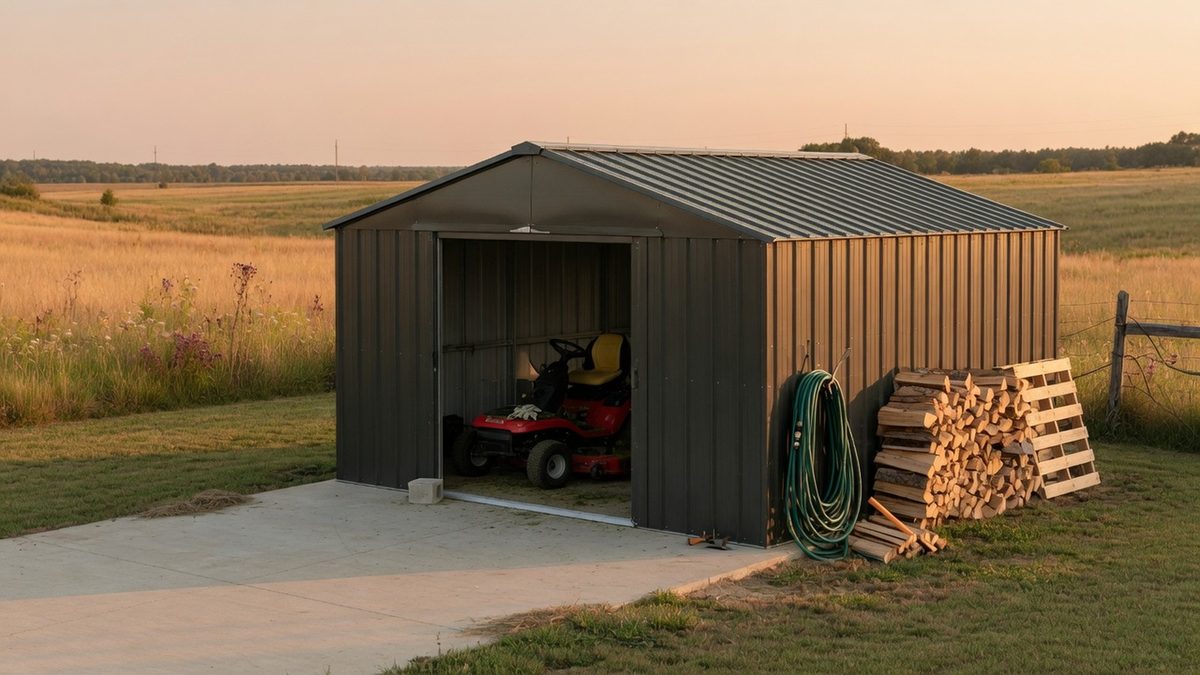
You are storing things that don't mind temperature swings or moisture. A riding mower, a snowblower, lawn tools, a wheelbarrow, bags of fertilizer, patio furniture in the off-season, bicycles. Things that are themselves rugged and don't care whether it's 40°F or 120°F inside the shed. This is the native use case for a good metal shed and it's a completely valid one.
You are on a rural property and you need a large building. Engineered steel buildings (Category 3) are often the right answer for barns, equipment storage, vehicle storage, workshops for rough work, and similar. The economics are hard to beat at larger footprints, and the products are genuinely engineered for the loads they have to handle.
You want fire resistance. Metal doesn't burn. For buyers in high-fire-risk areas — parts of California, Colorado, the interior West — this is a meaningful safety advantage over wood.
You want pest resistance. Metal is immune to termites, carpenter ants, wood-boring beetles, mice chewing through walls (they can still get in through gaps, but they can't chew through a steel wall), and most other things that bother wood structures.
You want the cheapest possible storage and you're willing to accept a 5- to 8-year replacement cycle. If your plan is genuinely to treat the shed as a disposable consumable, the Category 1 budget metal shed is honest about what it is.
You need it tomorrow. Metal kits are stocked at every big-box store in the country. You can load one in a pickup today, assemble it this weekend, and have stuff inside it by Monday. No other shed category has that speed of delivery.
When to walk away from metal
You want a workshop, office, studio, or conditioned space. The condensation and temperature problems make metal the wrong starting point, period. Choose wood, log, or a purpose-built modular backyard office.
You are in a humid climate and you care about the things you're storing. Cast iron tools, lumber, paper, electronics, leather, anything that rusts, rots, or mildews is going to suffer in a metal shed in humid conditions. Either mitigate aggressively or choose a different category.
You are in an HOA that prohibits metal sheds. A lot of HOAs do. Read your covenants before you buy anything.
You want a structure that looks good from the kitchen window and adds to your curb appeal. Metal sheds are utility, not aesthetics. Even the nicer ones look industrial. If your backyard has a view from inside the house, wood is almost always the better call for satisfaction.
You are a workshop user who told yourself "I'll insulate it later." You won't. Or if you do, it'll cost more than buying the right shed in the first place.
You are buying the cheapest kit at Home Depot because the price tag is appealing. Stop, do the full cost math including foundation and anchors and modifications, and ask whether the jump to a mid-tier option is really as far as it looks.
Questions to ask before you buy
- What is the gauge of the wall panels? The roof panels? The frame? (You want real numbers, not adjectives.)
- Is the steel galvanized, Galvalume, or Galvalume+powder-coated? (Galvalume is the better baseline for hot and coastal climates.)
- Is a floor included in the base kit, or is it a separate purchase?
- Is an anchor kit included? (Even if it is, you may want more anchors than the kit provides.)
- What is the actual warranty? What does it cover? (Most metal shed warranties cover rust perforation only — not denting, not deformation, not structural failure. Read the terms.)
- What are the engineered wind load and snow load ratings, in pounds per square foot? (If the answer is "we don't provide those," you are in Category 1 territory, and you should know it.)
- How many self-tapping screws does assembly require, and how long is the documented assembly time? (Over 400 screws and a 12-hour assembly time is a red flag for DIY buyers.)
- Does the manufacturer have a documented history of complaints, and if so, what are they about? (Check BBB, Trustpilot, and product reviews — not just the retailer's page.)
- Is the product currently in stock near me, and what's the return policy if I unpack the kit and discover it's damaged or incomplete? (This matters more than buyers expect.)
The bottom line
Metal sheds are the biggest, cheapest, most accessible shed category in America, and the distance between the good ones and the bad ones is the widest gap in any shed category we cover. At the bottom, the cheap big-box kits are, honestly, often a mistake — by the time you add up the real costs, they aren't meaningfully cheaper than better options, and the experience of owning one is worse than most buyers anticipate. In the middle, a well-specified 24- or 26-gauge shed from a mid-tier brand can be a sensible, honest, workmanlike choice for pure storage in a dry climate. At the top, engineered steel buildings are outstanding for farms, workshops (if you insulate properly), and large-footprint applications. The key to avoiding regret is understanding which tier you're actually buying into — and the best single thing you can do before you shop is simply ask for the gauge.
When you're ready to compare other directions, read our other deep-dive guides: Wooden Sheds (the closest thing to the "right way" to do a mid-price backyard shed), Plastic/Resin Sheds (the low-maintenance alternative), Cedar Sheds (if aesthetics are your priority), and Log & Timber Sheds (if you want a solid-wall structure that could credibly become a real workspace).
And whatever you choose — go bigger than you think you need, spend a little more than you think you have to, and pay attention to the foundation. Those three rules apply to every shed category, and they apply to metal most of all.