Why this article exists
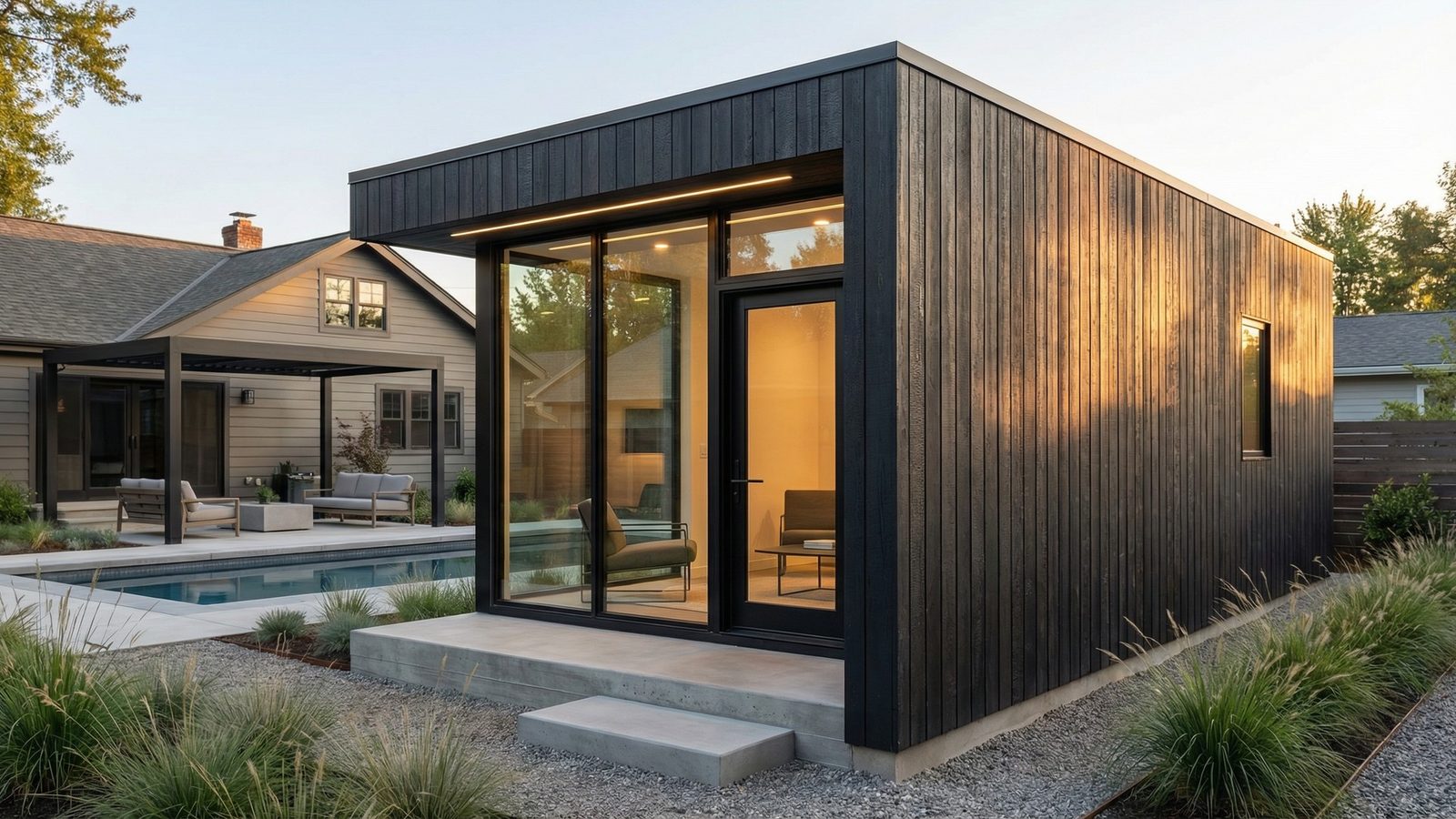
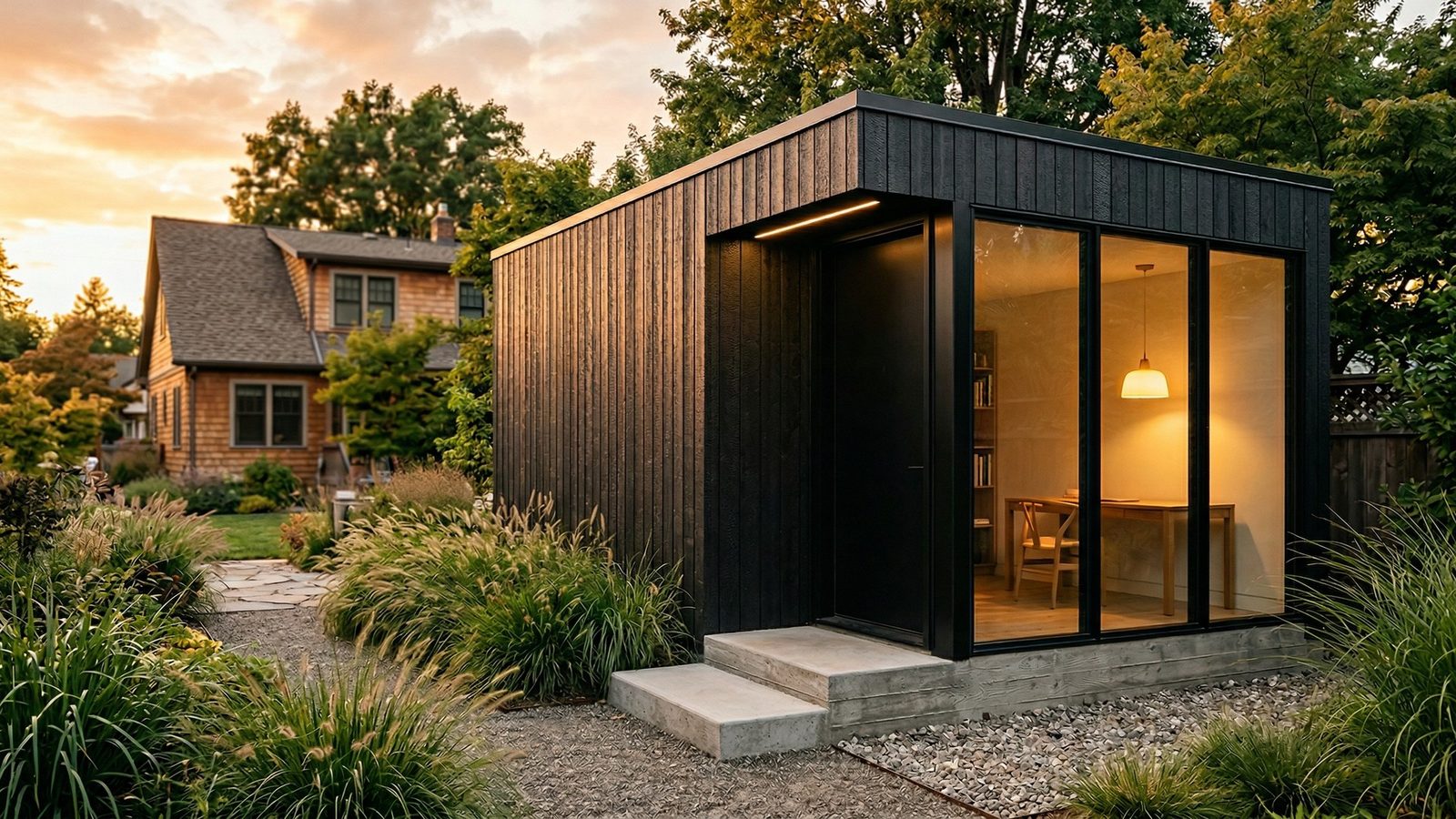
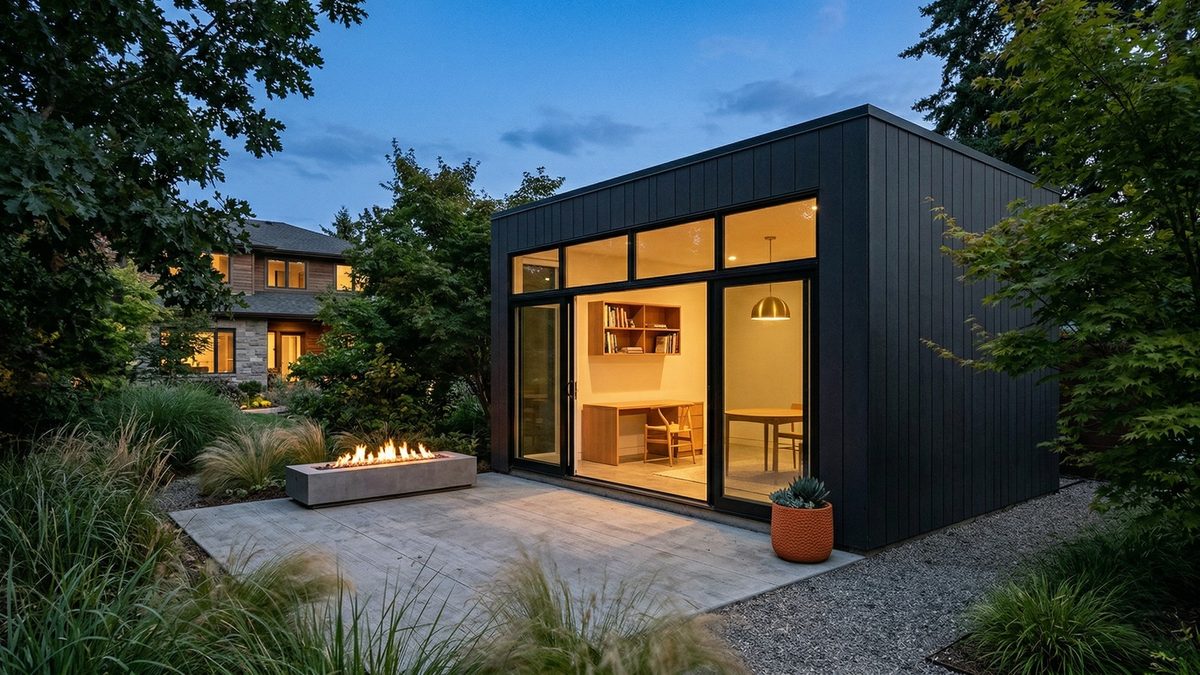
If you've been on Instagram, Pinterest, or Dwell.com any time in the last three years, you've seen them. Black-stained vertical wood. A flat or single-slope roof. One full wall of glass facing a quiet backyard. A black-frame sliding door cracked open onto a board-formed concrete pad. Maybe a linear gas firepit. Maybe ornamental grasses. Definitely no shutters, no gable peak, no white trim, no picket fence. The whole thing reads less like a shed and more like the smallest possible building an architect would actually agree to design.
This is the modern studio shed, and it is — by a wide margin — the fastest-growing visual category in the entire shed market. Searches for "backyard office" are up roughly 85% year over year. The "garden room" segment globally is growing at 11.4% annually. Seventy-nine percent of US employees now work remote or hybrid at least part of the time, and a meaningful percentage of them have figured out that the cheapest way to get one more room in the house is to put it outside the house. The modern studio shed is the structure they're putting there.
What almost nobody tells you up front is how wide the price spread inside this category really is. The same visual aesthetic — flat roof, dark cladding, glass wall — can cost you $5,995 for a Nordic spruce kit you assemble yourself in a weekend, or $278,800 for a turnkey prefab from a Bay Area startup, or anywhere on the long, expensive ladder in between. Most buyers walk into this category thinking they're shopping for a shed and walk out a few weeks later realizing they've accidentally been quoted on what is, financially and legally, a small house. The marketing photography is identical at both ends of the price spread. The reality is not.
This guide exists to close that gap. By the end you'll know exactly what a modern studio shed actually is, the five real price tiers, what each tier gets you and what each tier doesn't, where the brands honestly fit, what you actually need to budget once you add foundation and electrical and HVAC and permits, where the post-purchase regrets cluster, and how to tell — before you spend a dollar — which tier you're really shopping in.
What a "modern studio shed" actually is
"Modern studio shed" isn't really a construction category — it's a visual category and a use category, dressed up in a name that everybody understands faster than the longer phrases ("backyard office," "ADU studio," "garden room," "prefab pod") that mean roughly the same thing. The construction underneath that visual category varies enormously. The look does not.
The look has five fixed signatures. Once you know them, you can spot the category from across the street and tell within five seconds whether a structure is in it.
The first signature is the roof. A modern studio shed has a flat roof or a shallow single-slope (mono-pitch) roof. Never a gable. Never two slopes meeting in a peak. The flat roof is the single most important visual cue in the whole category, and it's the one that separates "modern shed" from "traditional shed" more reliably than any other single feature. If a shed has a gable, it's not in this category, even if everything else about it is dark and minimalist.
The second signature is the cladding. Modern studio sheds use vertical or horizontal wood plank siding in dark tones — black-stained shou sugi ban (the Japanese charred-wood technique), dark fiber-cement panels (think the high-end James Hardie lines), Corten weathering steel, black-stained vertical cedar with thin reveals, or the European spruce planks that Nordic kit makers ship across the Atlantic. The cladding is almost always darker than the surrounding house. The darker the cladding, the more architectural the structure reads.
The third signature is glass. A modern studio shed has at least one wall, or one big section of one wall, that is mostly or entirely glass. Floor-to-ceiling. Black or charcoal aluminum frames. Often a sliding glass door rather than a hinged door. The glass wall faces the most private corner of the yard, not the street. This is the move that separates "modern studio" from "modern garden shed" — you don't put a glass wall on a tool storage building, but you do put one on a writing studio.
The fourth signature is clean rectangular geometry. One single volume. Boxy. No shutters, no decorative trim, no dormers, no porches, no ornament of any kind. The whole structure should look like a single rectangular block that someone set down very carefully on the lawn. If there's any decoration, it's in the landscaping around the building, not on the building itself.
The fifth signature is the surroundings. Board-formed concrete pad or pavers. Gravel or river stone bed instead of mulch. Ornamental grasses, monolithic low planters, slim recessed exterior lighting (linear LED bars or wall-washers, never lantern fixtures). The landscaping is part of the look, and most of the most photographed examples of this category spent almost as much on the landscape design as on the building itself.
When all five signatures are present, you have a modern studio shed. When fewer than three are present, you have something else — even if the marketing copy uses the words "modern" and "studio." This matters more than it sounds, because the words "modern shed" get applied to a lot of products that are really just regular sheds with darker paint.
Is a modern studio shed actually right for you?
Modern studio shed buyers fall into one of about eight emotional camps, and the camp you're in matters more than any spec sheet. The eight camps come straight out of two years of forum reading, customer review mining, and direct interviews — they're not invented archetypes, they're the real people walking into this category with credit cards out.
The remote worker. You started working from your dining table in 2020 and you're still doing it in 2026. You've decided you cannot live another year without a real door between your job and your family. You want a quiet, well-lit, climate-controlled box with WiFi, a desk, and one comfortable chair. Budget range is realistically $15,000 to $45,000 all-in, and your decision timeline is two to six months. You are the largest single segment of this market and the one most modern studio shed brands are quietly aimed at.
The creative professional. Painter, designer, writer, photographer, ceramicist, woodworker. You need natural light, a big work surface, the ability to make a mess, and the freedom to leave a project in progress without negotiating it with anyone. Aesthetic matters to you almost as much as function — you're not going to spend two hours a day in a building you don't like looking at. Budget $18,000 to $60,000, timeline six to eighteen months. The full glass wall is non-negotiable; you came for the light.
The architect or designer. This buyer is the angriest in any modern studio shed forum, and the most articulate about why. They've been to Europe. They've seen what woodcab and Avrame and a dozen other Scandinavian brands ship at price points that simply do not exist in the US. They look at the American market and they say, in the now-famous Reddit thread, "America is so far behind." They will pay $50,000 to $150,000 if the design is right and they will pay nothing if it isn't. Timeline twelve to thirty-six months. They are the category's harshest critics and its most loyal evangelists when somebody finally builds something they approve of.
The tech professional. You make good money, you live in California or Utah or the Pacific Northwest, you want a backyard office that doubles as a status object, and you have the disposable income to skip the kit category entirely. Budget $25,000 to $80,000, timeline three to nine months. You will probably end up at Studio Shed, Modern Shed, or Autonomous and you will probably be reasonably happy unless you skipped reading the post-purchase reviews.
The wellness practitioner. Yoga teacher, massage therapist, meditation coach, sound healer. The structure is the business. It needs to feel beautiful and calming the moment a client walks in or it will hurt your bookings. The aesthetic standard is unusually high relative to the budget — $20,000 to $55,000, three to twelve months. You need real privacy, real soundproofing, and a vibe that does not read "shed."
The Airbnb investor. You ran the math on a backyard rental and the math worked. You need something that photographs well, fits in 200 to 400 square feet, has a real bathroom, and can be rented at $80–$200 a night. Budget $40,000 to $120,000, timeline three to nine months. You're already thinking about local short-term rental ordinances, occupancy permits, and how the structure will affect your property tax assessment. The modern studio aesthetic is non-negotiable because it's what photographs well in listings.
The empty nester. The kids moved out. You're thinking about downsizing but you're not ready to leave the house and the garden you spent twenty years building. A backyard studio gives you a place to host an aging parent, an adult kid in transition, or a future you-when-the-stairs-get-hard. Budget $45,000 to $150,000+, timeline six to eighteen months. You're really shopping for an ADU (see our shed-to-ADU guide), and the modern studio aesthetic is just the visual language that feels right.
The entrepreneur. Side business, e-commerce, podcast, consulting practice. You need a workspace that feels professional enough that clients on Zoom take you seriously, with enough room for shipping supplies, sample inventory, or a small studio setup. Budget $15,000 to $50,000, timeline three to twelve months. You want a building that pays for itself within two years through tax deduction or improved billable hours.
If you're reading those eight descriptions and thinking "I'm not really any of them — I just want a nicer place to drink my coffee," that's allowed too, and it's actually closer to one of those camps than you think. The trick is to be honest with yourself about which one you're really in before you start shopping, because every brand in this category is implicitly designed for one or two of those buyers and against the others.
The five real price tiers (and what each one actually buys you)
This is the section every buyer needs to read before they fall in love with a specific brand, because the category spans about a 50-to-1 spread in price and the marketing photography at the bottom of the spread looks almost identical to the marketing photography at the top. The difference is real, but it lives in the parts of the building you don't see in the catalog photo.
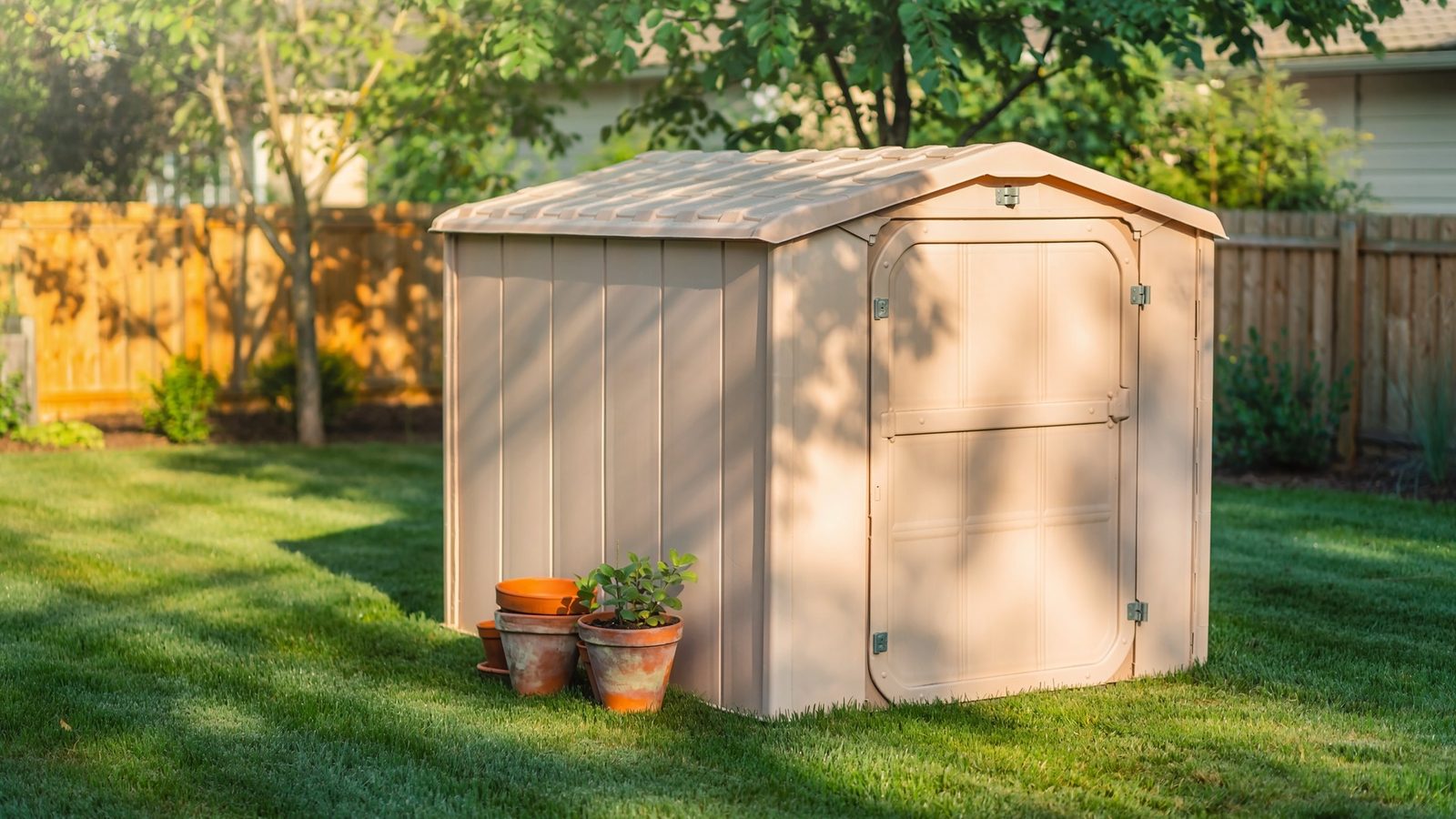
Tier 1 — Budget modern, $2,500 to $8,000. This is what you find at Lowe's, Costco, Home Depot, and the cheaper end of the online direct-to-consumer brands. Painted dark, sometimes with a metal roof that is technically flat-ish, sometimes with a fake "modern" facade glued onto what is structurally a normal shed. The construction is thin OSB or LP SmartSide, 2x3 framing, asphalt or cheap metal roofing, vinyl windows. The aesthetic almost lands but the proportions are usually off, the material is wrong up close, and the structure is not designed to be conditioned space. This tier is fine if you want a tool shed that doesn't embarrass you in the backyard. It is not where you buy a backyard office.
Tier 2 — Mid-range modern kits, $6,000 to $14,000. This is the tier where the modern studio shed actually starts to be real, and it is also the tier with the smallest number of legitimate players. The defining brand here is SolidBuild (more on the ownership relationship below — it matters). SolidBuild's Modern line ships European kiln-dried Nordic spruce in numbered panels you assemble yourself with one helper over a couple of weekends. The Moderna sells for $5,995 (80 sq ft), the Solana for $6,795 (80 sq ft plus a 40-sq-ft attached terrace), the Astoria for $8,595 (117 sq ft), and the California for $8,895 (117 sq ft with the strongest modern aesthetic). Trustpilot rating across the line is 4.8 out of 5 from 189+ reviews. Lead time is one to two weeks. There is, as far as we can find, no other US-available brand that ships real-wood, modern-design kits below $9,000. This is the most uncontested gap in the entire shed market, and it's the reason the next price tier feels so jarring when you encounter it.
Tier 3 — Premium prefab pods and signature kits, $15,000 to $30,000. This is the tier most American shoppers think of as "the modern shed market." It includes Studio Shed's Signature Series ($16,000–$20,000 for a 10x12 shell), Modern-Shed's smaller models, Autonomous WorkPod ($18,900–$19,900 for a 105-sq-ft pod), Kanga Room Modern ($18,900), Sheds Unlimited's modern line, and Modern Kwik Room ($15,555 for the smallest configuration). The aesthetic is clearly "modern studio shed." The cladding is usually LP SmartSide or fiber-cement painted dark. The glass is real but smaller than the marketing photography suggests. Foundation, electrical, HVAC, permits, and delivery are extra in every case. Trustpilot and Yelp ratings vary wildly — Studio Shed has a Yelp rating of 2.9 out of 5 driven by post-sale customer service complaints; Summerwood (Canadian, cedar-leaning) has a Trustpilot rating of 4.9 out of 5; Autonomous WorkPod has a documented "Georgia greenhouse" story where buyers in hot climates discovered the original glass package created an unworkable thermal load. This is the tier where careful brand research matters most.
Tier 4 — Studio ADUs, $40,000 to $200,000+. This is where "modern shed" stops being a shed and becomes a small habitable building. Studio Shed Summit 308 sits at the kit price of $98,029 with a typical all-in cost of $140,000 to $180,000. Kanga's 14x20 ADU Modern lands around $105,400 turnkey. The buildings are larger (200 to 600 square feet), include real plumbing rough-in, real insulation packages, and real residential window glazing. They require permits, foundations, and almost always a general contractor. Most buyers in this tier are no longer shopping for a shed at all — they're shopping for an ADU and the "modern studio" language is just the visual style.
Tier 5 — Premium prefab from architecture-led startups, $200,000 to $500,000+. Abodu Studio at $278,800. Cover. Plus Hus. These are full prefab dwelling units delivered nearly complete on a flatbed. The aesthetic is impeccable. The price is non-negotiable. The buyer in this tier is functionally building a small house and is comparing prefab speed-to-occupancy against custom site-built construction, not against shed kits. If you find yourself here, you're not in the same conversation as somebody pricing a SolidBuild Moderna, even though the photos look related.
The most honest thing we can say about the tier structure is this: the gap between Tier 2 and Tier 3 is where most buyer regret is born. People walk in expecting Tier 3 quality and price and discover Tier 2 doesn't really exist for them in their region (most modern shed kits are not available everywhere). Or they walk in expecting Tier 2 prices and discover Tier 3 is the only real option in their state. Or they fall in love with Tier 5 photography and realize too late that Tier 4 is what they can actually afford and Tier 3 is what they should actually buy. Knowing the tier you're really in, before you start shopping, is more valuable than any single product comparison.
Run your own numbers: Use our free From-Scratch Cost Calculator to estimate a full DIY build, or the Kit Cost Calculator if you're buying a prefab kit.
The honest aesthetic conversation
There is a real and underdiscussed cultural tension inside this category, and the architect/designer buyer above puts it more bluntly than anyone. Most American modern studio sheds are not actually as well-designed as the marketing makes them look. They are modern-flavored. They borrow the silhouettes and the color palette from genuinely architect-designed European studio buildings, but the proportions are usually off — too tall for the footprint, or too short for the door, or with window mullions that are too thick, or with cladding reveals that are too coarse. The buyers who have spent time in Europe, or who follow Scandinavian or Pacific Northwest design closely, see this immediately and it bothers them.
The brands that actually nail the proportions tend to be either (a) the European kit brands shipping into the US, (b) the small-batch American architect-led prefab companies in Tier 5, or (c) the original Pacific Northwest brands like Modern-Shed that built their reputations in Seattle's design community. Everyone else is doing a passable but imperfect imitation, and you should know that going in. It is not necessarily a deal-breaker — most buyers do not care, and the buildings still photograph well — but if you are in the architect/designer camp it is going to bother you no matter how nice the structure is, and you should weight that into your shopping accordingly.
The other piece of the aesthetic conversation that almost nobody mentions is how a modern studio shed ages. Black-stained shou sugi ban actually weathers beautifully — the charring locks the wood grain. Black-stained vertical cedar holds its color for three to five years before needing a re-coat. Painted LP SmartSide will need a touch-up paint job every five to eight years; the paint is doing the work, not the substrate. Dark fiber-cement panels hold up well but the joints between panels are where staining and weathering show first. Corten weathering steel does what it says on the tin — it rusts on purpose, intentionally and beautifully, and it is the lowest-maintenance option in this category, but the rust will run onto whatever pad it sits on, which is why you see Corten paired so often with gravel rather than concrete.
The five architectural styles that dominate this category are worth naming because they help you locate your own taste: Scandinavian Minimalist (light wood, white interior, restraint, the European kit aesthetic), Pacific Northwest Modern (warmer woods, darker exterior, more glass, the Modern-Shed aesthetic), Mid-Century Modern (cleaner lines, more emphasis on the indoor-outdoor connection, sliding glass doors taking up most of the front), Industrial-Modern Hybrid (Corten steel, exposed fasteners, rougher textures), and Biophilic Retreat (heavy emphasis on natural materials, green roofs, integration with planting, the "yoga studio in the woods" look). Most brands sit on one of these and try to pretend they cover all five. Decide which one you actually want before you fall in love with a brand that is anchored in a different style.
Materials reality: what you're really buying
Underneath the dark cladding, these buildings are made of one of about four things, and the difference matters more than the brochure suggests.
European kiln-dried Nordic spruce is the material in the SolidBuild Modern line and most of the European kit imports. It's a slow-grown softwood, dimensionally stable, naturally rot-resistant in the climates it grew up in (Sweden, Finland, Latvia), kiln-dried to 12–15% moisture, and shipped in numbered panels. It is real wood. It looks like real wood. It smells like real wood. It needs to be oiled or stained every two to three years to maintain color, but if maintained it will last 25–40 years in most US climates without structural issues. Buyers who have owned one for five-plus years are remarkably consistent in their reviews — Trustpilot 4.8 across 189 SolidBuild reviews is not an accident.
LP SmartSide is engineered wood fiber siding. It's used by Studio Shed, Sheds Unlimited's modern line, and many of the mid-tier American brands. It's pre-primed, pre-finished, and quite durable — the LP 50-year warranty is real and meaningful — but it is engineered wood, not solid wood. Up close it does not have the grain or the smell or the variation of real wood. From ten feet away most buyers cannot tell the difference. From two feet away most buyers can. Whether that bothers you is a personal call.
Fiber-cement panels (Hardie panel, Equitone, Cembrit) are the highest-end cladding in the mid-tier modern shed market and the dominant cladding in the Tier 4 and Tier 5 prefabs. They are essentially indestructible, hold paint extremely well, and give the cleanest "modern panel" look of any material. They are heavy, hard to work with for DIY assembly, and significantly more expensive than wood or LP. They are also the cladding most likely to read as genuinely architectural rather than "shed pretending to be architectural."
Corten weathering steel is the most distinctive option and the most polarizing. It's a steel alloy that intentionally develops a stable rust patina. It needs no paint, no maintenance, and no finish. It looks incredible against green plants. It will, however, run rust onto whatever it sits on, and it will not insulate well on its own (you build the insulated wall behind the Corten skin). It is rare in kit sheds and almost always custom or architect-spec.
Glass deserves its own paragraph because it's where the most expensive surprises happen. Single-pane glass is what cheap modern sheds use to hit a price point; it is a thermal disaster anywhere except the mildest climates. Double-pane low-E glass is what real backyard offices need; it is significantly more expensive and most kit brands will not include it as standard. Solar heat gain through a south-facing or west-facing glass wall can drive up to 49% of your peak summer cooling load in a small backyard structure. The buyers most upset about thermal performance in modern studio sheds are almost always the ones who didn't realize their unit shipped with single-pane or low-spec double-pane glass, and discovered it the first July after the building was finished.
The flat roof question
The flat roof is the visual signature of the entire category, and it is also the single feature most likely to be a source of post-purchase anxiety. The fear is straightforward and reasonable: flat roofs leak. Buyers have seen flat-roofed commercial buildings with ponding water, with tar patches, with sagging insulation. They have read the horror stories.
Here's the honest answer. A properly installed modern flat roof on a small backyard structure is not the same product as the failing flat roofs people are remembering. Modern small-structure flat roofs are not actually flat — they are sloped at minimum ¼ inch per foot (this is the IRC R903.4 minimum), which is enough to drain water without being visually obvious. The membrane is usually EPDM rubber (a single-ply roll roofing system), TPO, or modified bitumen, with a service life of 20 to 30 years if installed correctly. The leak risk on a small, properly drained, modern membrane roof on a 120-square-foot structure is genuinely low — not zero, but low enough that "flat roof" is not the disqualifier it sometimes feels like.
The two real things to verify before you commit:
- Is the slope drained to a defined edge? If the water has a place to go, you're fine. If it ponds, you're not.
- What membrane is on top, and what is its warranty? A 20-year EPDM warranty on a small structure means you should not have to think about the roof until Year 15 at the earliest.
The shallow single-slope (mono-pitch) roof is in many ways the safer cousin of the true flat roof. It maintains nearly identical visual language — the building still reads as flat from most angles — but the slope is more aggressive (often 1:12 or 2:12), drainage is unambiguous, and the membrane choice is wider. If a brand offers either a flat roof or a mono-pitch on the same model, the mono-pitch is usually the lower-anxiety choice for buyers who are nervous about flat roofs and live in heavy-rain or heavy-snow climates.
One climate-specific note: snow loads. In Colorado, the Mountain West, the upper Midwest, New England, and parts of the Pacific Northwest, building codes require roofs to be designed for 30 to 40 pounds per square foot of snow load (sometimes more in localized areas). Flat roofs in these regions need to be engineered specifically for that load. A SolidBuild kit shipped to Vermont and a SolidBuild kit shipped to Texas are not necessarily structurally identical — ask the manufacturer specifically what snow load the roof is rated for in your zip code, and if you're in heavy-snow country, factor that into your decision between flat and mono-pitch.
Thermal performance: the #1 post-purchase complaint in the entire category
If you only remember one thing from this guide, remember this paragraph. The single most common regret expressed by modern studio shed buyers across every brand and every price tier is that the building was thermally underperforming relative to what they expected. Hot in summer. Cold in winter. The HVAC running constantly. The mini-split working harder than it should. The big glass wall acting like a solar oven from May through September.
This is not a hypothetical. It is the story behind the now-famous "Georgia greenhouse" review of the Autonomous WorkPod, where a buyer in Georgia documented that his unit was unusable as an office in summer because the south-facing glass and the engineered-panel walls created interior temperatures the included climate control could not manage. The review went viral inside the modern shed community, and Autonomous quietly improved the glass package in later production runs. But the underlying issue is not unique to one brand. It is structural to the category.
Here's why. Modern studio sheds are small. Small buildings have a high surface-area-to-volume ratio, which means heat moves in and out of them faster than it does in a normal-sized house. They have big glass walls, and even good double-pane glass insulates worse than an insulated stud wall. They are built on slabs that store and release heat slowly. They are usually a single open volume with no interior walls to slow air movement. And they are climate-controlled by a single small mini-split system that has to handle the entire envelope from one fixed location.
The 2021 IECC code minimum for insulation in conditioned space is R-20 in walls and R-49 in roofs in most US climates. Most kit modern sheds in Tier 2 and the lower end of Tier 3 do not ship with anything close to that. The walls are usually R-13 to R-19, and the roofs are usually thinner than buyers assume because the flat-roof construction does not allow as much depth as a vented attic does. If you are putting your modern studio shed in any climate hotter than San Francisco or colder than Seattle, you need to think hard about how much insulation it actually has and whether you need to upgrade before the structure is closed up.
The four things to verify before you sign:
- What is the actual R-value of the wall and roof assembly as shipped? Get a number, in writing.
- Is the glass single-pane, double-pane standard, or double-pane low-E? This is the single highest-leverage spec in the whole building.
- Is the floor insulated? Slab-on-grade buildings lose enormous amounts of heat through the floor in cold climates. A continuous foam under the slab matters.
- What size mini-split is recommended for your specific climate zone? A 9,000 BTU unit will work in coastal California and fail in Phoenix or Atlanta.
If a brand cannot answer those four questions clearly and in writing, that is a signal. The brands that take thermal performance seriously will give you clear specs and clear recommendations. The brands that don't will hand-wave.
What it really costs (the all-in math nobody shows you)
Every modern studio shed brand publishes a kit price. Almost no brand publishes the all-in price, because the all-in price is much larger and harder to explain in a marketing email. Here is the honest list of line items for a typical 120-square-foot modern backyard office, in roughly the order you'll spend the money.
| Cost item | Typical range | Notes |
|---|---|---|
| Kit or unit price | $6,000–$30,000 | The number on the catalog page |
| Site prep and grading | $800–$2,500 | More if your yard slopes |
| Foundation (concrete pier or slab) | $1,200–$5,000 | Piers are cheaper; slab is required for true ADU use |
| Delivery / freight | $300–$2,500 | Sometimes included in promotions |
| Assembly labor | $0 (DIY) – $4,500 | DIY possible on European kits, harder on premium prefabs |
| Interior finishing (flooring, paint, trim) | $1,500–$5,000 | Some kits include this, some don't |
| Electrical sub-panel and underground conduit | $2,500–$5,000 | Same cost regardless of which kit you bought |
| Mini-split HVAC system + installation | $3,000–$4,500 | Almost never included |
| Insulation upgrades (if needed) | $1,000–$3,500 | Critical in hot or cold climates |
| WiFi mesh extender | $150–$300 | The single cheapest line item, almost always forgotten |
| Permit fees | $200–$1,500 | Varies wildly by jurisdiction |
| Realistic all-in for a 120-sq-ft conditioned office | $15,000–$60,000 | Depending on tier |
The single most useful exercise you can do before shopping is to take the kit price you're falling in love with, double it, and ask yourself if you'd still want the project at that number. For most buyers in Tier 2 and Tier 3, doubling the kit price gets you remarkably close to the realistic all-in. For Tier 1, doubling underestimates because the cheap kit doesn't include enough of the building. For Tier 4 and Tier 5, the kit price is closer to the all-in because more is included from the factory.
One useful real-world reference: a SolidBuild California kit ($8,895) finished as a true conditioned home office with electrical, HVAC, and DIY assembly comes in at about $20,495 all-in. A Studio Shed Signature 10x12 with the same finish level lands at about $46,000 all-in. An Autonomous WorkPod Versatile lands at about $36,500 all-in. That gap is the gap that defines this market — the same end product, three very different prices, and the price differences are mostly about what is and isn't included in the kit, not about quality differences in the finished building.
The brand landscape (with a disclosure block before we go any further)
Disclosure: ShedScout is editorially independent, but our parent ownership also operates SolidBuildWood.com, which sells the Nordic spruce kit line discussed below. We disclose this relationship every time SolidBuild appears in our coverage. We have done our best to write about SolidBuild the same way we write about every other brand — naming the strengths, naming the weaknesses, and pointing out where it doesn't fit. If you want a totally outside perspective, we recommend reading the Reddit r/AlternativeHousing and r/Tinyhouses threads on each brand, where buyers compare notes without any commercial relationship to anyone.
With that out of the way, here are the brands that actually matter in the modern studio shed market in 2026, organized by tier, with what they're good at and what they're not.
Studio Shed (Boulder, CO). The most recognizable brand in the category. Signature Series 10x12 around $18,000 for the shell. Available nationwide through their installer network. Their marketing photography is the gold standard — most of what you've seen on Pinterest with the words "modern shed" attached came out of their catalog. Strengths: brand recognition, design consistency, real installer network. Weaknesses: the post-sale customer service rating on Yelp (2.9/5) reflects a real pattern of complaints about contractor quality and warranty fulfillment, the shell prices do not include enough finishing for a real office, and the all-in cost is significantly higher than the kit price suggests.
Modern-Shed (Seattle, WA). The Pacific Northwest original. No published prices on most models — you fill out a form and get a quote, which is a deliberate choice that some buyers find annoying and some find appropriate for the level of customization. Typical project lands in the $25,000–$50,000 range. Strengths: actual Pacific Northwest design culture behind the company, well-proportioned buildings, strong reputation among architects. Weaknesses: pricing opacity, slower lead times, smaller geographic reach.
SolidBuild (California, family ownership disclosed above). The European kiln-dried Nordic spruce kit line at the only sub-$9,000 price point in the real-wood modern shed market. Moderna $5,995, Solana $6,795 (with attached terrace), Astoria $8,595, California $8,895, Washington $18,495. Trustpilot 4.8 from 189+ reviews. Lead time one to two weeks. Strengths: actual real wood, the only brand at this price point in this aesthetic, strong reviews, fast delivery, DIY-friendly assembly with numbered panels. Weaknesses: requires you to do (or hire out) the assembly, requires you to spec your own foundation and electrical, glass packages are smaller than the premium prefab competitors, smaller models cap at 117 sq ft with the larger Washington being the only true office-sized option in the line.
Autonomous WorkPod. $18,900–$19,900 for a 105-sq-ft pod. Strengths: real attempt at an integrated turnkey product, included flooring and interior, fast shipping. Weaknesses: documented thermal performance issues in hot climates (the "Georgia greenhouse" story), Chinese manufacturing supply chain raises long-term durability questions, glass seals and weather stripping have shown up in repair complaints around year three, customer service mixed.
Kanga Room Systems. Modern line at $18,900. Strengths: good design, customizable, well-respected. Weaknesses: turnkey installation only available in Texas, kit-only purchase elsewhere, smaller geographic footprint than Studio Shed.
Summerwood Products. Canadian, cedar-leaning, Trustpilot 4.9/5. Strengths: extremely strong customer satisfaction, real wood, good construction. Weaknesses: cedar-focused (which is its own conversation — see our cedar shed guide), cross-border shipping into the US now carries lumber tariffs that have moved prices up, leans more "modern garden room" than "modern studio."
Sheds Unlimited (Pennsylvania). Strong Amish-built construction, modern line uses LP SmartSide, regional dominance in the Northeast. Strengths: build quality, regional reputation, customization. Weaknesses: aesthetic leans more "modern-flavored shed" than "true modern studio."
Allwood / Lillevilla. Finnish kit cabins. Often shows up in modern shed searches but is genuinely a different category — these are log cabin kits, not modern studio aesthetics. Don't shop them as if they were Tier 2 modern.
Plus Hus, Cover, Abodu. Tier 5 architectural prefab. $200,000+. If you find yourself comparison shopping these against a SolidBuild Moderna, you are not really shopping in the same market and you should sit with that fact for a minute before you proceed.
The brand to pay closest attention to is the one whose post-purchase reviews most often mention the things that matter to your specific use case. Customer service matters more if you're not a confident DIY person. Real wood matters more if you're an aesthetic buyer. Thermal performance matters more if you're in Texas, Arizona, Florida, or anywhere with serious winters. Match the brand to your real priorities, not to whichever Instagram photo caught your eye first.
The 12-year ownership arc
Owning a modern studio shed is not like owning a normal shed, because modern studio sheds are usually doing more work — they're conditioned space, they get used daily, they hold furniture and electronics, and the buyer's emotional investment is much higher. Here's roughly what the 12-year arc looks like for a well-built kit assembled and finished correctly.
Year 1. Honeymoon. The building is fresh, the wood (if real wood) still smells like the European warehouse it shipped from, the glass is spotless, and the interior feels like the most photogenic room you own. You take more photos in the first six weeks than you'll take in the rest of the building's life. You discover that working from a separate building is actually as transformative as the marketing promised, and you wonder why you waited so long.
Year 2 to 3. First maintenance moment. If you have natural wood cladding, this is when it needs its first oiling or restaining. If you have LP SmartSide, this is when you might notice the first paint dulling on the south-facing wall. If you have a flat roof, this is when you should clean the membrane and check the drainage edge. The building is still beautiful, but it has stopped being effortless.
Year 4 to 6. Thermal honesty. By now you know exactly how the building performs in your climate. You've adjusted the mini-split, possibly added thermal curtains to the glass wall, possibly added a ceiling fan, possibly insulated the floor retroactively if you skipped it the first time. You either love the building or you've quietly accepted its limitations.
Year 7 to 9. Mid-life refresh. Real wood gets its second or third re-stain. The HVAC mini-split is probably approaching the end of its first service life and may need replacement (Year 12 is typical). The interior may want a paint refresh. If you're going to upgrade anything — better glass, more insulation, new flooring — this is when you do it.
Year 10 to 12. The honest performance review. By Year 12, the buyers who bought correctly are still using the building daily and would buy it again. The buyers who bought into the wrong tier are usually one of three things: (a) they upgraded the building substantially to make it work, (b) they downgraded their expectations and use it for storage now, or (c) they replaced it. The flat roof membrane might be approaching its first re-coat. The siding is showing real character. The total ownership cost over 12 years is now visible, and it's the comparison nobody made for them when they were buying.
The 20-year total cost of ownership math is striking. A Studio Shed Signature 10x12, finished as a real office, lands at about $64,000 over 20 years — about $3,200 per year of ownership. An Autonomous WorkPod Versatile lands at about $52,700 over 20 years, about $2,635 per year. A SolidBuild California, DIY-assembled and finished as a real office, lands at about $28,795 over 20 years — about $1,440 per year, with a per-square-foot 20-year cost of about $246/sq ft versus Studio Shed's $533/sq ft. The gap is real, and it's the single biggest financial argument inside this category.
That math is not the whole story, of course. The Studio Shed buyer is paying for brand recognition, contractor installation, and a stronger resale signal. The Autonomous buyer is paying for delivery speed and integrated finish. The SolidBuild buyer is paying less but doing more of the work themselves. There is no universally correct answer — only the answer that matches your real priorities and your real constraints.
The top regrets (in rank order)
After mining about two years of forum threads, customer reviews, and direct buyer interviews, the regrets cluster in a remarkably consistent rank order. If you only read one section before buying, read this one.
-
"I didn't budget for the all-in cost." (★★★★★) By far the most common regret. The buyer fell in love with the kit price and discovered the project price six weeks later. Almost universal in Tier 1 and Tier 3.
-
"The thermal performance was worse than I expected." (★★★★) The Georgia greenhouse story in miniature. Hot summers, cold winters, glass walls, undersized HVAC.
-
"I wish I'd gone with a more proven brand." (★★★★) Buyers who chased the cheapest option and discovered the company had mixed reviews or disappeared during the warranty period.
-
"I underestimated the permit and HOA hassle." (★★★★) Especially in California, Colorado, and HOA-governed neighborhoods. By the time you discover the permitting reality, you've already spent money.
-
"The flat roof made me anxious for years before I realized it was fine." (★★★) A pure peace-of-mind cost. The roof itself almost never actually leaked, but the buyer spent years worrying about it.
-
"The customer service after the sale was a nightmare." (★★★) Specific to a few named brands. Read post-sale reviews carefully, not just the showroom reviews.
-
"I should have gone bigger." (★★★) The most common regret about spec rather than process. 80 sq ft feels great until the second person needs to be in there. 117 sq ft is the floor for a real one-person office. 200 sq ft is the floor for an office that can occasionally host a meeting.
-
"The aesthetic in person was less impressive than the photos." (★★★) Especially common with Tier 1 and the lower end of Tier 3. The marketing photography is always the best version of the product.
-
"I wish I'd insulated the floor." (★★) Almost universal in cold climates among buyers who didn't.
-
"The neighbors complained more than I expected." (★★) Modern studio sheds are visually distinctive and can read as "weird" in traditional neighborhoods. Not usually a deal-breaker but worth a frank conversation before you build.
The regrets that don't show up in the top ten are also revealing. Almost no one regrets buying real wood. Almost no one regrets the glass wall — the people who have it, love it, even when they wish it had been better-spec'd. Almost no one regrets the fact that the building is small, unless they're in regret #7 above. The category, on balance, makes most buyers happy. The buyers who get hurt are almost always the ones who didn't do the all-in math up front.
When a modern studio shed is the right answer
A modern studio shed is the right answer for you if:
- You have a real, recurring use for a separate building — daily work, daily creative practice, daily client visits, daily wellness practice. Not occasional. Daily.
- You can afford the all-in cost (kit + foundation + electrical + HVAC + finishing + permits) without straining your finances. Use the doubling rule on the kit price.
- You have a yard with a reasonably flat 12x16 or larger footprint, accessible for delivery and assembly.
- Your local jurisdiction allows accessory structures of the size you want, with permits you can actually obtain. Check before you buy.
- You're emotionally honest about the maintenance cycle on whatever cladding you pick.
- You care enough about the look that the modern aesthetic is genuinely worth the premium over a nice traditional shed at half the price.
When to walk away (and what to buy instead)
A modern studio shed is the wrong answer if:
- You only need the building two or three times a month. A normal mid-tier wooden shed at half the price is a smarter buy. See our wooden shed guide.
- Your budget is genuinely under $10,000 and you cannot DIY the assembly. Tier 2 doesn't really exist for you in that case, and Tier 3 will not fit the budget once you add foundation and electrical.
- You need a real second dwelling — guest space, rental income, aging-parent space — with a full bathroom and a kitchen. You're not in this category, you're in the ADU category. See our shed-to-ADU guide.
- You live in an HOA that flat-out prohibits modern aesthetics or accessory structures. The fight is not worth it.
- You're shopping for "the cheapest backyard office" without caring about aesthetics. A metal shed with a window kit (see our metal shed guide) will do the same job for one-third the money.
- You're really shopping for a traditional she-shed or cottage feel. Modern is not your category — see our cedar shed guide instead.
Questions to ask before you spend a dollar
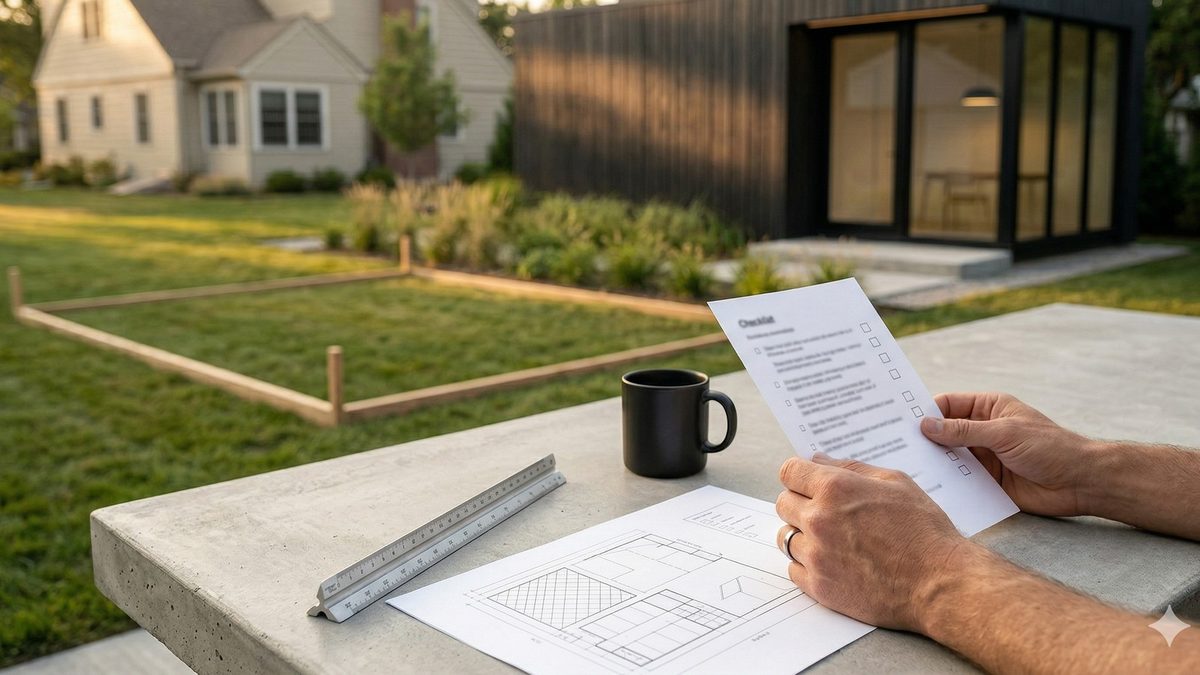
Print this list. Ask the brand directly. Get the answers in writing. If a brand can't or won't answer, treat that as a signal.
- What is the actual R-value of the wall and roof assembly as shipped?
- Is the glass single-pane, standard double-pane, or low-E double-pane? What is the U-value?
- What is the recommended mini-split BTU rating for my climate zone and footprint?
- What is the snow load rating of the roof, and is it adjusted for my zip code?
- What is the warranty on the structure, on the cladding specifically, and on the roof membrane specifically? Is the warranty transferable on resale?
- Does the kit include a vapor barrier, and if so, where in the wall assembly is it?
- Is the floor insulated as shipped, and if not, what's the recommended retrofit?
- What's the realistic delivery lead time to my zip code today (not the marketing number)?
- Is assembly DIY-able for two people, or does it require a contractor?
- What's the realistic all-in cost, including foundation, electrical, HVAC, and permits, for a fully finished office in my zip code?
- What's the company's customer service policy if a panel arrives damaged or a part is missing?
- Where is the company actually based, and where is the manufacturing?
The answers to these twelve questions will tell you more about whether a brand is a fit than every Pinterest photo you've ever pinned.
Bottom line
The modern studio shed is the most aspirational shed category in 2026, and for good reason — when it works, it transforms how people work, create, and live in their own backyards. It is also the category with the widest gap between the marketing dream and the financial reality, and the buyers who get hurt are almost always the ones who fell in love with a $6,000 kit price and discovered $30,000 of project costs they didn't see coming.
Three things will protect you. First, know your tier before you start shopping — the five tiers in this guide are real, the gaps between them are real, and most buyer regret is born in the gap between Tier 2 and Tier 3. Second, double the kit price as a quick all-in test before you fall in love with any specific product. Third, ask the twelve questions above and get the answers in writing — the brands that take this category seriously will answer them clearly, and the ones that don't will tell you something important by their silence.
If the math works for you and you're in one of the eight buyer camps above, this is one of the best uses of $20,000 to $50,000 you can make in your home in 2026. The buyers who get the all-in budget right and pick the brand that matches their real priorities are, almost without exception, glad they did it. The category is real. The dream is real. The trick is making sure your version of the dream has the foundation, the wiring, the insulation, and the permits to actually live in.
Disclosure: ShedScout is editorially independent. Our parent ownership also operates SolidBuildWood.com, which sells the Nordic spruce modern shed kit line discussed in this guide. We have done our best to write about SolidBuild with the same honesty we write about every other brand in the category, including naming where it doesn't fit. Independent reviews of every brand mentioned are easy to find on Trustpilot, Yelp, and the r/AlternativeHousing and r/Tinyhouses subreddits, and we encourage you to read them before making any purchase.
Written for ShedScout.com by the editorial team. Last updated April 2026.