Why this article exists
If you've spent an hour clicking through Home Depot, Costco, and Amazon, you've probably noticed that plastic sheds are the easiest thing in the world to buy and the hardest thing in the world to actually understand. The boxes say "maintenance-free," "UV-resistant," "easy assembly," and "10-year warranty." The reviews say something else entirely.
This guide pulls together what the brands tell you, what material scientists know about how plastic actually behaves outdoors, and what real owners report 3, 5, and 10 years after the box arrives at the curb. By the end you'll know exactly when a plastic shed is the right answer for your situation, when it's a quiet mistake, and what to ask before you spend a dollar.
No affiliate pressure here. Just the truth.
What "plastic shed" actually means
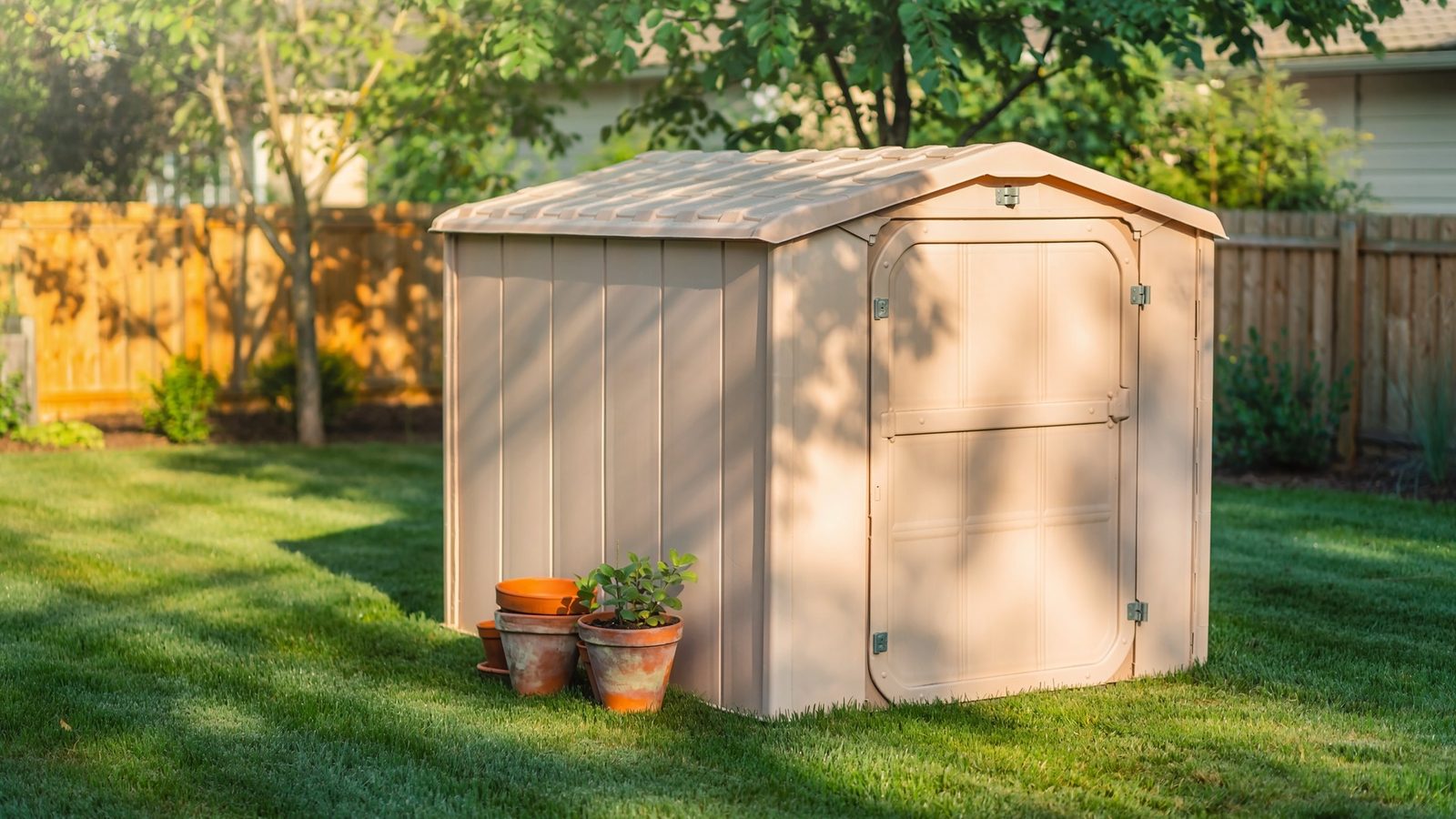
The phrase covers at least five different products. They look similar in photos but behave very differently in your backyard.
HDPE (high-density polyethylene) is what Lifetime uses. It's a dense, tough plastic — the same family as the heavy-duty pipe that lasts 50+ years underground. Lifetime sheds are double-walled (two skins of HDPE with a hollow cavity between them) and reinforced with powder-coated steel trusses inside the walls and roof. They're the heaviest and structurally strongest option in the category.
Polypropylene (PP) is what Keter uses, shaped through injection molding. PP is a little lighter, a little stiffer, and lets the manufacturer create the realistic wood-grain textures Keter is known for. The trade-off: PP gets brittle in extreme cold faster than HDPE. If you live somewhere that hits -20°F, this matters.
Blow-molded resin is the Suncast approach. Walls are formed in a single hollow operation, which keeps cost down and adds a tiny bit of insulation, but the surface finish and dimensional precision tend to be lower than HDPE or injection-molded PP.
Vinyl-clad steel is the Duramax approach. Underneath, it's actually a galvanized steel frame; the "plastic" is rigid PVC panels that snap into the steel skeleton. Structurally, this is the strongest plastic-category shed because the steel carries every load. The weak point is the steel-to-vinyl interface, which expands and contracts at different rates with temperature.
Polycarbonate is what Palram/Canopia uses for the roof — a translucent, glass-like plastic that lets light through. Pretty for greenhouses and gardening sheds, but Palram's Trustpilot reviews are some of the worst in the category for wind durability.
When someone in a forum says "I have a plastic shed," they could mean any one of these. The category is not a category. It's five categories pretending to be one.
Is a plastic shed actually right for you?
Before we go any further into materials, brands, and failure modes, here's the honest gut check. Plastic is the right answer for a pretty narrow set of situations, and being clear about which one you're in will save you a thousand dollars and a lot of frustration.
You're probably in the right place if you can say yes to most of this: you need to get bikes, a mower, and garden tools out of your garage; your budget is somewhere under $1,200; you're not planning to put anything valuable enough that you'd be heartbroken if it disappeared; and the words "low maintenance" matter more to you than the words "workshop" or "office." If that's you, plastic can genuinely be a smart, fast, low-stress decision.
You're probably in the wrong place if any of this sounds familiar: you want a space you'd describe as a room — somewhere to work, build, write, or hide from the kids on a Sunday afternoon. You want to run electricity, hang heavy shelves, insulate it, or someday convert it to a hobby space. You're imagining the shed lasting 20+ years and adding value to your home. You're shopping above $1,500. Any of those, and we'd quietly steer you toward the wood-frame, cedar, or solid-build guides instead. Plastic isn't built for what you're picturing, and you'll know it within two years.
A few specific situations where plastic almost always wins, even if the rest of this article scares you: you've been burned by a wood shed that rotted or needed constant painting and you never want to repeat that experience; you're physically unable to maintain a wood structure and the alternative is no shed at all; or your HOA explicitly requires a non-wood material (and has approved plastic — many HOAs reject it too, so always check before you buy).
And one situation where plastic almost always loses, even though people keep trying: "I'll take it with me when I move." Assembled plastic sheds are very difficult to take apart without damaging the panels, and reassembly rarely goes smoothly. Portability is the most over-promised benefit in the category. If that's your main reason for buying, the story doesn't survive contact with a moving truck.
Still here? Good. Let's get into what you're actually buying.
The lifespan question (the one nobody answers honestly)
Every brand claims 10 to 20 years. Every retailer lists 5 to 7. Every owner forum tells you it depends entirely on three things: how hot your sun is, what you put it on, and how you care for it.
Here's the timeline that emerges when you average hundreds of real owner reports against the material science:
Years 1–2. It looks great. You feel smart. The doors close. The roof is rigid. This is the honeymoon. Brands rely on this stage for their reviews — most Amazon reviews are written within 60 days of delivery.
Years 3–5. Color shift starts. Panels turn slightly chalky. South- and west-facing walls lead the change. If you live in Phoenix, Las Vegas, or south Texas, you're already noticing it. If you live in Seattle or Maine, you might still be in the honeymoon.
Years 5–8. Doors start to drift out of alignment. Hinges fatigue. The latching mechanism that worked perfectly on day one now needs a shoulder bump to close properly. Screw holes elongate. Panel seams develop small gaps.
Years 8–12. Hindered Amine Light Stabilizers (HALS) — the chemical that protects colored plastics from UV — begin to deplete. After this point, degradation accelerates. Cracks appear at stress points, especially around screw holes and roof panel edges. Impact resistance drops 30–50%.
Years 12–15+. Panel cracking under load is now a real risk. Roof failure becomes possible. In high-UV environments (Arizona, Nevada, southern California), compress this entire timeline by 40–60% — meaning the structural-risk stage hits at year 7 or 8, not year 12.
The honest summary: in a moderate climate on a good foundation with light colors, a quality plastic shed is a 10–15 year asset. In a brutal climate on a poor foundation with dark colors, it's a 5–7 year asset. Neither outcome is the "lifetime" the marketing implies — and neither is the "junk" the harshest forum critics claim.
The failure modes you need to know about
Brands talk about features. Owners talk about failures. Here's what actually goes wrong, in roughly the order it happens.
Door alignment is the universal complaint. Across every brand, in every climate, the single most consistent failure is doors that stop closing properly within the first one to three years. The mechanism is almost always the same: the foundation shifts even slightly, the snap-together panel system has zero tolerance for that shift, and the doors — which depend on perfect plumb to latch — start binding. One Reddit installer who has built dozens of plastic sheds professionally summed it up: "Every single one I've done... it's the same bloody issue. I'm surprised there isn't a recall."
UV degradation is real, predictable, and worse than the brochure. Lifetime markets sheds as "UV protected and designed to stand up to weathering." Keter says theirs "resist UV rays" and "won't crack, rot, or peel." Both statements are technically true and practically misleading. The HALS chemistry that makes UV resistance possible is consumed over time. Once it runs out, plastic degrades quickly. Dark colors absorb 60–80% of solar radiation; light colors only 20–30%. If you have any choice in color, pick the lightest one available.
Heat is a bigger problem than you'd guess. Plastic sheds are solar collectors. Documented interior temperatures regularly exceed 130–140°F in summer. One owner measured a 40°F differential — outside in the 50s, inside above 90°F — before summer had even started. The practical consequences: tool batteries swell or fail, fertilizer becomes a fire risk, anything with electronics degrades, paint cans warp.
Condensation rusts the things you put inside. This is the one almost no buyer expects. Warm humid air enters during the day; at night, temperatures drop and that moisture condenses on cold panels and metal tools. "In my old shed I would get rust from condensation overnight" is a comment you'll find in dozens of forums. Even Keter's own website acknowledges: "You open the shed to grab a tool, and bam! There it is. That musty smell."
Wind without anchoring turns your shed into a projectile. Standard plastic sheds are typically rated for 70 mph. Florida's building code requires 150–180 mph. Without anchoring to a foundation, plastic sheds have been documented blowing across yards into neighbors' fences. "The wind gust yesterday blew the neighbor's shed into our yard" is not hyperbole — it's a Tampa Reddit post. Anchoring isn't optional. Treat it as part of the purchase.
Snow load is a real ceiling. Lifetime's official 8-foot shed supports 22.5 PSF (pounds per square foot) of snow load — 30 PSF with the optional snow kit. A moderate two-foot snowfall of heavy wet snow can exert 42 PSF, which exceeds even premium plastic sheds. By contrast, residential wood-framed structures handle 30–50+ PSF, and northern building codes often require 40–70 PSF. If you live where snow stays on roofs for weeks, you'll need to clear it actively.
Security is largely theatrical. Plastic walls can be cut with a utility knife. Door frames can be torn off hinges with five pounds of pressure. The padlock on a plastic shed protects the honest — it does almost nothing against anyone determined. Most experienced owners self-censor what they store inside: bikes, tools, and lawn equipment yes; the $600 Milwaukee drill set, no.
Customization is almost nonexistent. Plastic walls are hollow double-skin panels. Standard fasteners cannot bite into them. You cannot hang a heavy shelf the way you would in a wood shed. You cannot run electrical without serious workarounds. You cannot insulate. You cannot add a loft. The community-upvoted solution on r/DIY for plastic shed customization is to build a freestanding 2x4 frame inside the plastic shed — which is itself the loudest possible signal that the structure cannot do basic organizational work on its own.
The brand landscape, briefly and honestly
You'll see roughly six names most often. Here's the short, fair version of each.
Lifetime Products. American-made HDPE with steel reinforcement throughout. Structurally the strongest in the category, the widest size range (8x5 up to 20x8), and the longest-tenured brand at major retailers like Costco and Sam's Club. Trade-off: assembly is genuinely difficult — 15+ hours is normal for a large shed, and the instructions are widely criticized as confusing. Assume two to three people, a full weekend, and no plans afterward. Typical price range: $1,250–$3,599.
Keter Group. Israeli-owned, polypropylene resin, known for snap-fit assembly and the most realistic wood-grain textures (Evotech+ and DecoCoat finishes). Best aesthetic in the category by a clear margin. The catch: Keter's US BBB rating is an F, and their warranty/parts experience varies wildly — UK Trustpilot is 4.3 out of 5, US owner reports skew much harsher. Missing or damaged parts on delivery is the single most common complaint. Price range: $350–$2,199.
Suncast Corporation. Blow-molded polypropylene out of Illinois. Cheapest of the major brands, widest retail availability, and home of the most damning review paradox in the category: an A+ BBB rating alongside a 1.4-out-of-5 Trustpilot score. The BBB rating measures whether Suncast responds to complaints; Trustpilot measures whether the response actually helps. Roof cracking within two to three years is the most-cited failure. If you buy Suncast, buy it with realistic expectations. Price range: $599–$1,399.
Duramax (US Polymers). Vinyl-clad steel — the structural odd-one-out. The steel frame makes Duramax the strongest plastic-category shed by a real margin, and the 15-year warranty is the longest in the industry. The wood-grain vinyl is also the best in class. The trade-off: not sold at Home Depot or Lowe's, so most buyers never encounter it. If you want plastic durability without compromising on look, this is the most under-discussed option in the category. Price range: $799–$4,219 depending on size.
Palram/Canopia. Polycarbonate roof on aluminum frame. Useful for one specific person: the gardener who wants a translucent roof for plant light without electricity. Almost nobody else should buy this brand. Trustpilot 2.0 out of 5, severe wind vulnerability, multiple "destroyed by wind after 6 weeks" reports.
Rubbermaid. Effectively exiting the walk-in shed market. Their current lineup is mostly horizontal storage and deck boxes. If you see a Rubbermaid walk-in shed at a deep discount, it's likely discontinued — which means parts will be impossible in two years. Skip.
The foundation problem (the most important paragraph in this article)
If you remember nothing else, remember this: the foundation matters more than the brand.
Real-world owner data shows the same pattern over and over. Plastic sheds on solid, level concrete or compacted gravel routinely reach 10–15 years even in moderate-UV climates. Plastic sheds placed directly on bare soil in high-UV environments commonly fail at 5–8 years. The difference is not the shed. The difference is the ground underneath it.
Here's why. Plastic shed walls are thin panels held in alignment by a snap-together or screw-together system that depends on perfect plumb. The ground underneath a shed is not stable — soil moves with frost heave in winter, with moisture in spring, with compaction over time. Even small movements cause panels to shift relative to each other, which causes door alignment failures, which causes weather to enter, which causes the rest of the failure cascade. A Reddit comment that summarizes a thousand others: "You are going to need to make sure that the ground is 100% level. The plastic pieces do not do well even with small differences."
The two acceptable foundations are:
A 4-inch poured concrete pad sized to the exterior of the shed. Most expensive option ($300–$800 depending on size and whether you DIY), most permanent, eliminates moisture wicking entirely. This is what the Duramax warranty actually requires.
A compacted gravel pad with a pressure-treated wood frame perimeter, typically 4–6 inches of crushed stone over a leveled and tamped base. Cheaper ($150–$400 in materials), still stable, drains well, and works for almost every plastic shed. This is what most owners successfully use.
What is not acceptable: bare grass, bare soil, unlevel patio pavers, or "I just put some 2x4s under the corners." If you don't want to do the foundation work, you don't actually want a plastic shed — you want a deck box. Be honest with yourself before you buy.
The price ceiling that almost nobody talks about
There's a number where plastic stops making sense, and it's lower than you'd guess: $1,200 to $1,500.
Below that, plastic is a clear value. A $700–$1,000 Suncast Tremont or Keter Factor solves the storage problem fast, requires only basic foundation prep, and pays for itself versus a $119/month self-storage unit in roughly 8 months. At this price, plastic is doing exactly what it should: removing one specific friction (where do I put my mower) for the lowest possible total cost.
Above $1,500, the math changes. A homeowner shopping at $1,800 for a Keter Stronghold or a Lifetime 10x8 is suddenly within striking distance of a small wood-framed shed kit. At $2,500–$3,000, you can buy a real cedar shed or a basic solid-wood shed kit. At $3,500, you're in the territory of premium wood structures with 30–50 year lifespans, full customization, electrical-ready construction, and real resale value.
The Reddit comment that captures this inflection better than any chart: "I think this is truly one of those 'buy once, cry once' scenarios. The wood option is going to cost more in time and/or materials, but with reasonable maintenance it should last a lifetime or more. I can't imagine a plastic shed will do the same."
If you find yourself looking at a plastic shed above $1,500, pause. Open a tab on a wood shed comparison. Compare 10-year total cost, not sticker price. Plastic almost always loses that comparison.
When a plastic shed is absolutely the right answer
After all that, plastic is genuinely the best choice in a real and specific set of situations:
You need storage fast, your budget is firmly under $1,200, and you have a level spot or are willing to build a simple gravel pad.
You live somewhere humid where wood rots quickly, and the trade-off of UV degradation in 8–12 years is better than the trade-off of rot in 5–7.
You are physically unable to maintain a wood shed and the alternative is having no shed at all. This is the buyer for whom "maintenance-free" is a literal accessibility feature, not a marketing line.
Your HOA explicitly requires non-wood material, and you cannot get an exception.
You are buying for a specific bridge period of 5–8 years (rental, planned move, planned upgrade) and you have made peace with treating the shed as a consumable expense rather than an asset.
You only need to store low-value items — bikes, plastic toys, hoses, garden tools, the lawn mower — and you have nowhere else to put them.
In all of these cases, buy with clear eyes: light color, smallest size that meets your real need (then go one size up), good foundation, anchored, and lower expectations than the marketing. A plastic shed bought this way will reward you for years.
When to walk away
Walk away if any of the following are true:
You want a workshop, a hobby space, an office, or anything you would describe as a room.
You need to store anything valuable enough that you'd be upset if it walked away with someone holding a utility knife.
You live somewhere with extreme heat and harsh winter cold and high UV. Phoenix and Las Vegas are the obvious examples, but inland California, west Texas, and parts of Nevada qualify too. The lifespan you'll actually get is half what the brochure suggests.
You're shopping above $1,500. You're being out-competed by wood and you don't know it yet.
Your HOA has not been consulted. The forum stories of plastic sheds being purchased, assembled, and then ordered torn down by an HOA review board are disturbingly common.
You are unwilling to build a real foundation. Without it, every other decision you make about brand and model is irrelevant.
The questions to ask before you buy
If you've decided plastic is the right call, run through this checklist before you put anything in a cart. These are the questions that separate a 12-year shed from a 5-year shed.
What am I actually putting in here? Write the list. Measure the biggest item. Then add 30% for the things you forgot. Then size up one footprint above what that number suggests. Buyers who don't do this almost always end up wishing they had bought larger — "size regret" is the most-repeated piece of advice in every forum, in every climate.
What's my UV climate? If your summer UV index regularly hits 11+, your plastic shed will age 40–60% faster than the brochure assumes. Buy light colors. Plan for shade if possible. Adjust your lifespan expectations downward.
What foundation will I actually build? Be honest. If the answer is "I'll figure it out later," you do not yet want a plastic shed. You want to read the foundations guide first.
Will I anchor it? If the answer is no, you should not buy a plastic shed. This is not optional in any climate that has wind, which is every climate.
Has my HOA said yes in writing? Verbal approval is worthless. Get it in writing before delivery.
What's the warranty actually cover? Read the actual document, not the marketing. Pay particular attention to the clauses about "proper foundation," "improper assembly," and "cosmetic damage" — these are the three exclusions most commonly cited in denied claims across all brands.
What's the total 10-year cost? Add purchase price + foundation + anchoring + the realistic chance of replacement at year 8–12 in your climate. Compare that number — not the sticker price — to a wood shed alternative. Sometimes plastic still wins. Often, especially above $1,200, it doesn't.
Run your own numbers: Use our free From-Scratch Cost Calculator to estimate a full DIY build, or the Kit Cost Calculator if you're buying a prefab kit.
The bottom line
Plastic and resin sheds are real tools that solve real problems for real people. They are also surrounded by more marketing distortion than almost any product category in the home-improvement world. The truth is in the middle: if you buy the right one, at the right price, for the right reason, on the right foundation, you will get 10–15 years of useful storage and never think about it. If you buy the wrong one, you will be on a Reddit forum venting in 18 months.
The ShedScout view: plastic deserves to be in the conversation, but it should rarely win the conversation when the budget crosses $1,500 or the use case crosses "storage." Below that line, on a good foundation, in a moderate climate, with realistic expectations? It can be the smartest decision you make.
Above that line? You almost certainly want one of the other four shed types in our guide. Read those next.
Last reviewed: April 2026. ShedScout writes shed-type guides to help you understand your options, not to push you toward any single brand. We may earn a commission if you buy through our comparison tools, but our shed-type recommendations are independent of any affiliate relationship.
Next step: Take the ShedScout shed-type quiz to see which of the five shed categories actually fits your situation, or read the other shed-type guides — Wood Frame, Cedar, Solid Build (Log), and Metal/Steel — to compare honestly before you decide.